
Date
Sugar
The Whole-Food Sweetener That Actually Nourishes You
Date sugar is made by grinding whole dried dates into a fine powder. Unlike white sugar — which is chemically refined and stripped of every nutrient — date sugar retains all the fiber, iron, potassium, magnesium, and antioxidants naturally present in the whole fruit. It is sweet, nourishing, and genuinely better for your body. This complete guide covers everything: what it is, how it’s made, how it compares to white, brown, and coconut sugar, and exactly how to use it in baking and everyday cooking.
Why Are More People Switching to Date Sugar?
Because it is the only granulated sweetener made from a whole food — every teaspoon delivers real fiber, minerals, and antioxidants alongside its natural sweetness. Studies suggest it may cause a slower blood sugar rise than refined sugar, making it a genuinely smarter choice for health-conscious households.

What You Will Learn on This Page
- ✓ Date sugar is made from 100% whole dried dates — no refining, no bleaching, no additives — making it the most nutrient-dense granulated sweetener available.
- ✓ It retains 8g of dietary fiber per 100g — compared to zero fiber in white or brown sugar — which may help slow glucose absorption and support digestive health.
- ✓ Use it in a 1:1 ratio as a direct substitute for white or brown sugar in baking — reduce oven temperature by 10°C to account for faster browning.
- ✓ Date sugar outperforms white sugar, brown sugar, and even coconut sugar in nutritional density — particularly for fiber, potassium, and antioxidant content.
- ✓ You can make date sugar at home with dried dates and a high-speed blender — or find it at health food stores and online retailers.
Table of Contents
What Is Date Sugar?
Date sugar is exactly what its name implies: whole dried dates that have been dehydrated until completely moisture-free and then ground into a fine, granulated powder. The result is a natural, whole-food sweetener that carries every nutrient present in the original fruit — the dietary fiber, the potassium, the iron, the magnesium, and the polyphenol antioxidants — all intact in every teaspoon you use.
This stands in dramatic contrast to conventional refined sugars. White sugar begins as sugarcane or sugar beet juice that is extracted, filtered, boiled, centrifuged, and chemically bleached — a multi-stage industrial process that strips away everything except pure sucrose crystals. Brown sugar is simply white sugar with a small amount of molasses added back. Neither provides any nutritional value beyond calories.
Date sugar has a mild, warm sweetness with subtle caramel and fruity notes — a more complex and satisfying flavour than the flat sweetness of refined sugar. Because it is made from whole fruit, it does not dissolve completely in liquids (the fiber content prevents this), which means it works best in dry baking applications. For drinks and sauces, date molasses or date paste are more suitable alternatives.
Understanding the distinctions between the three main date-based sweeteners helps you choose the right one for every application:
Date Sugar
Ground dried dates — fine powder, use like granulated sugar in baking and sprinkling
Date Syrup
Liquid from boiled dates — use like honey or maple syrup for drizzling and drinks
Date Paste
Blended whole dates — soft and moist, use in baking for texture and natural sweetness
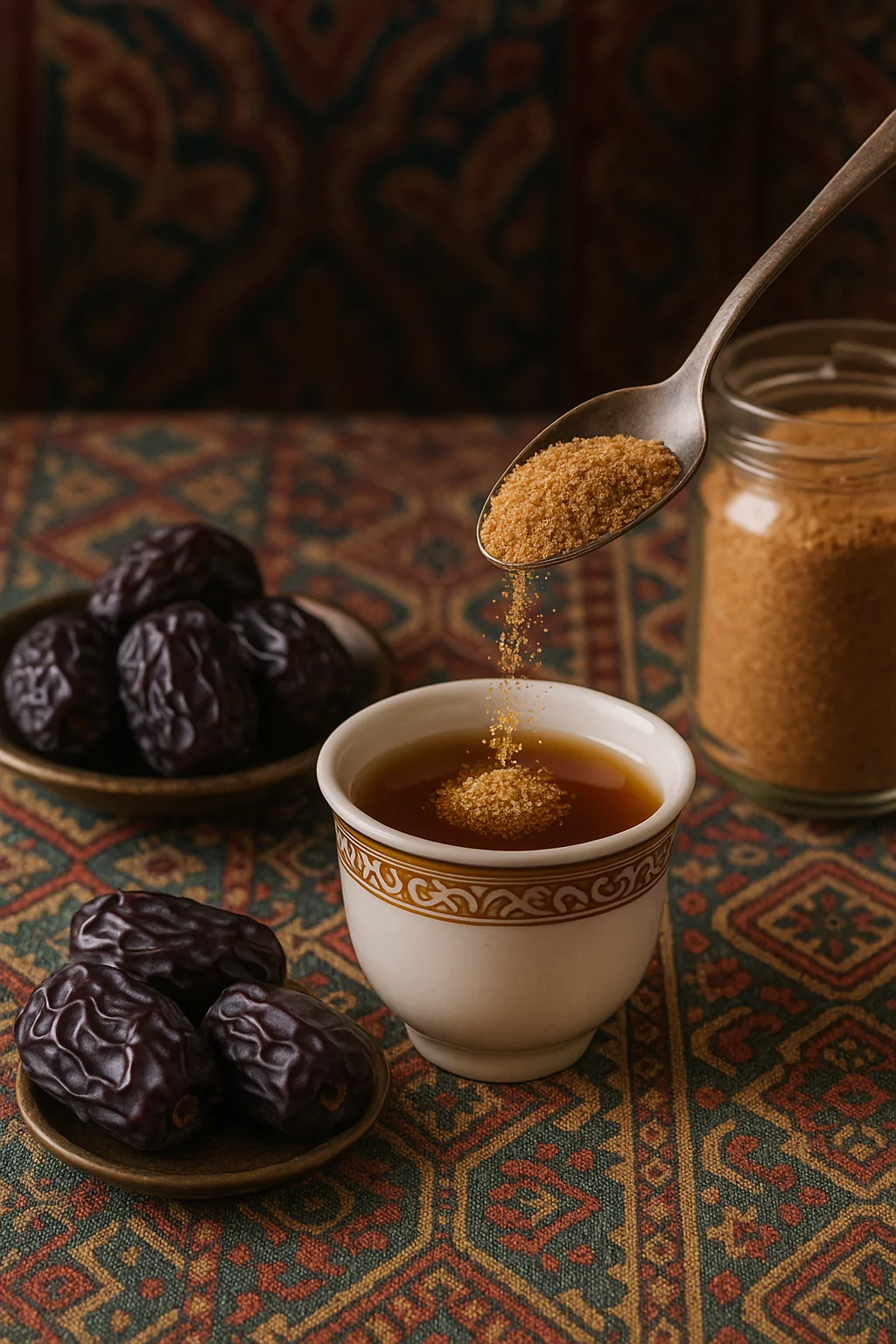
How Date Sugar Is Made
The commercial production of date sugar is a remarkably simple process compared to the chemical-intensive refining required for white sugar. Here is how premium date sugar goes from fresh fruit to the jar on your shelf.
Select Dates
Premium ripe Medjool or Deglet Noor dates are selected and pitted carefully
Slice & Prep
Dates are sliced into thin pieces to maximise surface area for even drying
Low-Heat Dry
Dried at low temperature (under 60°C) to remove all moisture while preserving nutrients
Grind Fine
Completely dry dates are ground in high-speed equipment to a uniform fine powder
Sift & Pack
Sifted to remove coarser pieces, then sealed in airtight packaging for freshness
🏠 How to Make Date Sugar at Home
Making your own date sugar at home is surprisingly straightforward and ensures maximum freshness. You need only dried dates and a high-powered blender or food processor.
- 1 Select and pit your dates. Use Medjool or Deglet Noor dates — both work well. Remove all pits carefully. Slice dates into thin pieces for faster, more even drying.
- 2 Dehydrate completely. Spread on a parchment-lined baking tray in a single layer. Dry in an oven at 100°C (212°F) for 2–3 hours, or use a food dehydrator at 57°C (135°F) for 6–8 hours. The pieces must be completely hard, brittle, and moisture-free — any remaining moisture will cause the powder to clump.
- 3 Cool completely before grinding. This is important — warm dates will turn into a sticky paste rather than a powder. Allow the dried pieces to cool to room temperature for at least 30 minutes.
- 4 Process to a fine powder. Blend in a high-speed blender or food processor until a uniform powder forms. Work in short pulses if needed to avoid overheating the motor. Sift through a fine mesh sieve to remove any larger pieces — re-blend the remainder.
- 5 Store correctly. Transfer to an airtight glass jar. Store in a cool, dry place away from sunlight and humidity. Home-made date sugar lasts approximately 3–6 months. If clumping occurs, sift before use.
6 Key Benefits of Date Sugar
Date sugar is not merely a sweetener — it is a whole food that delivers genuine nutritional value with every teaspoon. Here is what makes it meaningfully different from every other sweetener on the market.
Rich in Real Nutrients
Because date sugar is made from the whole dried date fruit with nothing removed, it retains every mineral and vitamin present in the original fruit. Each teaspoon provides potassium (important for heart function and blood pressure regulation), iron (essential for energy and oxygen transport in the blood), magnesium (supporting muscle and nerve function), and calcium. White sugar, by contrast, provides absolutely none of these — it is 100% sucrose with zero nutritional value beyond calories. This makes date sugar the only sweetener that genuinely contributes to your daily mineral intake.
- Supports heart and blood circulation
- Helps combat tiredness and low iron levels
- Provides natural, sustained energy from whole food
Better Blood Sugar Response
Date sugar has a notably lower glycemic index than refined white sugar or even brown sugar. This is primarily because it retains the dietary fiber naturally present in whole dates — approximately 8 grams per 100g. Dietary fiber physically slows the digestion and absorption of sugars in the gut, producing a more gradual, moderated rise in blood glucose rather than the sharp spike and subsequent crash associated with refined sugars. Research published in the journal Nutrition suggests that the natural sugars in dates may be metabolised differently from isolated fructose or sucrose, producing a more favourable blood sugar response when consumed in typical food quantities.
- May be suitable for diabetics in moderation (consult your doctor)
- Provides steady, sustained energy without energy crashes
- Helps reduce sugar cravings through better satiety signalling
Superior for Baking & Cooking
Date sugar can replace white or brown sugar in a 1:1 ratio in virtually every baking application — cookies, cakes, muffins, granola bars, pancakes, and more. It adds a naturally occurring mild caramel flavour that many bakers consider an upgrade over the flat sweetness of refined sugar. Because it contains natural fruit sugars that caramelise at slightly lower temperatures, it produces beautifully golden baked goods with a depth of flavour that processed sugar cannot replicate. It also adds natural moisture to baked products, which improves texture and extends shelf life slightly compared to white sugar equivalents.
- 1:1 substitute in most baking recipes — no adjustment needed for quantity
- Blend easily into smoothies, date seed coffee, and hot drinks
- Works beautifully as a topping for oats, yoghurt, and date desserts
Safe for the Whole Family
Date sugar is 100% natural, chemical-free, and contains no preservatives, artificial additives, or processing chemicals. This makes it genuinely safe for children, pregnant women, and elderly family members. Traditional communities across the Middle East, North Africa, and South Asia have used date-based sweeteners for centuries — long before modern nutritional science confirmed their health benefits. During pregnancy, the iron and potassium in date sugar may provide additional benefit beyond simple sweetness. Always use in age-appropriate quantities for young children and consult a healthcare professional if you have specific medical concerns. Learn more about the benefits of dates during pregnancy.
- No artificial preservatives, additives, or bleaching agents
- Chemical-free production — just whole dried dates, nothing else
- Gentle on the digestive system; well-tolerated by most people
Excellent for Digestion
The 8 grams of dietary fiber per 100g of date sugar is a genuinely significant nutritional advantage over all other common sweeteners. Dietary fiber serves multiple critical functions in the digestive system: it feeds beneficial gut bacteria (acting as a prebiotic), adds bulk to stools to support regular bowel movements, and creates a physical barrier in the gut that slows the absorption of sugars and fats. Every time you use date sugar instead of white sugar, you are contributing to your daily fiber intake — something no other sweetener can claim. Research suggests adequate dietary fiber intake is associated with reduced risk of type 2 diabetes, cardiovascular disease, and certain digestive disorders.
- Provides meaningful dietary fiber in every teaspoon used
- Acts as a natural prebiotic to support beneficial gut bacteria
- May help prevent constipation and support long-term gut health
Packed with Antioxidants
Whole dates are exceptionally rich in polyphenol antioxidants — particularly flavonoids, carotenoids, and phenolic acids. These compounds protect cells from oxidative stress caused by free radicals, which is associated with accelerated ageing, inflammation, and increased disease risk. Because date sugar is made from whole dried dates with no refining, it retains essentially all of these protective compounds. By contrast, white sugar contains zero antioxidants. Even brown sugar, which retains a small amount of molasses, contains only trace quantities. Choosing date sugar over refined alternatives means your sweetener is actively contributing to your body’s antioxidant defence rather than simply adding empty calories.
- Retains polyphenols lost entirely during sugar refining
- May support immune system function and reduce inflammation
- No antioxidant compounds are destroyed or removed during processing
Date Sugar vs. White, Brown & Coconut Sugar
The most comprehensive comparison available — 12 criteria across the four most commonly used sweeteners. See exactly why date sugar is the nutritional leader.
| Criteria | Date Sugar ⭐ | White Sugar | Brown Sugar | Coconut Sugar |
|---|---|---|---|---|
| Made From | Whole dried dates | Refined sugarcane/beet | White sugar + molasses | Coconut palm sap |
| Processing Level | Minimal — whole food | Highly refined | Highly refined | Low-moderate |
| Dietary Fiber | ~8g per 100g ✓ | 0g — none | 0g — none | ~1g per 100g |
| Glycemic Index | Low (~42–55) | High (~65) | High (~64) | Moderate (~35–54) |
| Calories per 100g | ~300 kcal | 387 kcal | 380 kcal | 375 kcal |
| Potassium | ~650mg ✓ | 0mg | ~133mg | ~1030mg |
| Iron | ~1.5mg ✓ | 0mg | 0.1mg | ~0.9mg |
| Antioxidants | High (polyphenols) ✓ | None | Trace (molasses) | Low-moderate |
| Dissolves in Liquid | Partially (due to fiber) | Fully ✓ | Fully ✓ | Mostly ✓ |
| Baking 1:1 Substitute | Yes ✓ | N/A (baseline) | Yes ✓ | Yes ✓ |
| Chemical-Free | Yes — 100% natural ✓ | No — bleached | No — refined | Yes ✓ |
| Flavour Profile | Rich caramel & fruity | Plain sweet | Mild molasses | Mild caramel |
* Values are approximate and vary by variety, processing method, and brand. Date sugar leads on fiber, nutrients, and antioxidants. Coconut sugar leads on potassium but provides significantly less fiber.

How to Use Date Sugar in Baking
Date sugar is remarkably versatile in the kitchen. Here is everything you need to know to get perfect results every time you substitute it for conventional sugar.
Cookies & Biscuits
Works perfectly in all cookie recipes. Date sugar produces cookies with a slightly chewier texture and golden-brown colour due to faster caramelisation. Reduce oven temperature by 10°C and watch carefully in the last few minutes of baking.
Cakes & Muffins
Excellent in dense, moist cakes like banana bread, carrot cake, and date cake. Adds natural moisture and depth of flavour. For lighter sponge cakes, combine with date paste for best texture. Baked goods may darken slightly faster than with white sugar.
Pancakes & Granola
The ideal application for date sugar — it blends seamlessly into pancake batter and granola mixtures, adding a warm, caramel sweetness. No dissolving required. Simply mix in as you would brown sugar for immediately superior results with no technique changes needed.
Hot Drinks
Stir into tea, coffee, warm milk, or herbal infusions. It will partially dissolve — stir well and give the beverage a minute to absorb before drinking. For fully smooth sweetened drinks, use date molasses instead which dissolves completely.
Smoothies & Blends
In blended smoothies, date sugar is completely undetectable in texture. Add 1–2 teaspoons to any smoothie in place of honey or syrup. It blends beautifully with banana, cacao, almond butter, and oat milk combinations. Also excellent in avocado date smoothies.
Sprinkling & Topping
Sprinkle directly over oatmeal, yoghurt, cereal, or toast with nut butter. Its granular texture and caramel sweetness make it an ideal topping that dissolves slightly on contact with warm or moist foods. Also beautiful as a finishing sugar on muffin tops and scones before baking.
Substitution Ratios at a Glance
Nutritional Value per 100g
The complete nutritional profile of date sugar — every mineral, vitamin, and compound retained because nothing is removed during production.
| Nutrient | Amount per 100g |
|---|---|
| Calories | ~300 kcal |
| Total Carbohydrates | ~75g |
| Natural Sugars | ~66g |
| Dietary Fiber | ~8g |
| Protein | ~2.5g |
| Fat | ~0.4g |
| Potassium | ~650mg |
| Magnesium | ~60mg |
| Calcium | ~80mg |
| Iron | ~1.5mg |
| Phosphorus | ~90mg |
| Antioxidants (Polyphenols) | High — retained from whole fruit |
| Vitamins B6 & B3 | Present — trace amounts |
| Artificial Additives | None — 100% whole food |


How to Use Date Sugar Daily
Incorporating date sugar into your daily routine is straightforward. It replaces white or brown sugar in a 1:1 ratio in most applications, so you do not need to recalculate recipes or purchase any special equipment. Start by swapping it in your morning oats or tea and work from there.
Simple Ways to Use Date Sugar Every Day
From morning to evening, date sugar fits seamlessly into every part of your day. Here are the most practical and delicious applications:
- Stir into morning tea, Arabic coffee, or warm milk for natural sweetness
- Sprinkle over overnight oats, porridge, or yoghurt as a topping
- Use in cookies, muffins, banana bread, and granola bars in place of white sugar
- Blend into smoothies for clean, natural sweetness with added fiber
- Add to baby food for children over 12 months as a natural, nutrient-rich sweetener
- Use as a coating for no-bake date balls or a finishing dust on stuffed dates
1–2 teaspoons per day is ideal for most healthy adults. Date sugar is natural, but it still contains calories and natural sugars — enjoy it as part of a balanced diet rather than in unlimited quantities.
- Airtight glass jar — essential to prevent moisture absorption
- Cool, dry location away from direct sunlight and heat
- Shelf life: 6–12 months (commercial) / 3–6 months (home-made)
- If clumping occurs, sift before use — still perfectly safe to eat
Where to Buy Date Sugar
Date sugar is becoming increasingly widely available as demand for natural sweeteners grows. Here are the four best places to find high-quality date sugar in 2026.
Health Food Stores
Specialist health food retailers such as Holland & Barrett, Whole Foods Market, and similar natural food stores typically stock date sugar in their natural sweetener sections. Staff can usually advise on quality and sourcing.
Middle Eastern Grocers
Specialist Middle Eastern and Arab grocery stores are an excellent source of premium date sugar, often stocking varieties made from high-quality Medjool or Ajwa dates imported directly from Saudi Arabia, Jordan, or Iran.
Online Retailers
Amazon, iHerb, and specialist natural food websites offer a wide selection of date sugar brands with customer reviews to guide your choice. Look for products labelled “100% dates” with no added ingredients for guaranteed purity.
Make It at Home
The freshest option of all — make your own date sugar from premium dried dates using an oven and blender. The DIY method in the section above produces a superior, ultra-fresh product and costs significantly less than commercial varieties.
💡 What to Look For: When buying commercial date sugar, look for products labelled “100% dates” or “contains: dates” as the only ingredient. Avoid any product with added sugar, preservatives, or anti-caking agents. Premium quality date sugar is typically made from Medjool dates and has a warm amber-brown colour with a naturally sweet, caramel-like aroma. Compare current date pricing to estimate the fair cost of premium date sugar.
Frequently Asked Questions About Date Sugar
Everything you need to know about date sugar — from production and substitution ratios to health considerations and storage. These are the questions we receive most often from readers making the switch from refined sweeteners.
What is date sugar made from?
Date sugar is made from 100% whole dried dates that have been completely dehydrated to remove all moisture and then ground into a fine granulated powder. Nothing is removed, refined, or added — the entire date fruit, including its fiber, minerals, vitamins, and polyphenol antioxidants, is preserved in the final product.
This makes date sugar fundamentally different from every other common sweetener, which undergo significant industrial processing that strips away nutritional content. Date sugar is the only granulated sweetener that qualifies as a whole food.
Is date sugar healthier than white sugar?
Yes — significantly so. Date sugar retains all the fiber (approximately 8g per 100g), potassium, iron, magnesium, and polyphenol antioxidants naturally present in whole dates. White sugar is chemically refined and bleached, producing pure sucrose crystals that provide zero nutritional benefit beyond calories.
Date sugar has a lower glycemic index, meaning it produces a more gradual blood sugar rise. Its fiber content may further slow glucose absorption, contributing to better blood sugar management over time. For anyone looking to reduce their refined sugar intake without sacrificing sweetness, date sugar is one of the most nutritionally sound alternatives available.
How do you make date sugar at home?
Making date sugar at home requires only dried dates and a high-powered blender. Pit the dates, slice into pieces, and dry in an oven at 100°C (212°F) for 2–3 hours until completely hard and brittle. Allow to cool fully — this is critical, as warm dates will paste rather than powder. Blend in short pulses until a fine powder forms, sift, and store in an airtight jar.
The full step-by-step guide with temperatures, timing, and storage instructions is provided in the “How It’s Made” section above.
Can people with diabetes use date sugar?
Date sugar has a lower glycemic index than white or brown sugar, and its natural fiber content may help moderate glucose absorption. Some research suggests that the natural sugars in whole dates may produce a more favourable blood glucose response than equivalent amounts of refined sucrose. However, date sugar still contains significant natural sugars and calories.
People managing diabetes should use date sugar in strict moderation, monitor their blood glucose response carefully, and consult a qualified healthcare professional or registered dietitian before making any dietary changes. Do not use this information as a substitute for personalised medical advice.
What is the substitution ratio for date sugar in baking?
Use date sugar in a straightforward 1:1 ratio to replace white or brown sugar in most baking recipes. No quantity adjustment is required. However, two technique adjustments will improve your results: reduce the oven temperature by approximately 10°C (because date sugar’s natural sugars caramelise and brown faster), and add 1–2 tablespoons of extra liquid to your batter (because date sugar absorbs slightly more moisture than refined sugar due to its fiber content).
Date sugar cannot be used as a substitute in recipes that require sugar to fully melt or caramelise into a liquid — such as traditional caramel, toffee, or hard candy — because the fiber prevents complete liquefaction. For all dry baking applications, it is an excellent substitute.
Does date sugar dissolve in tea or coffee?
Date sugar partially dissolves in hot liquids but does not dissolve completely the way white sugar does. The dietary fiber in date sugar physically cannot dissolve in water — this is what makes it valuable nutritionally, but also means it leaves a slight texture in beverages when stirred.
For hot tea or coffee: stir well and allow the drink to sit for 1–2 minutes before consuming. In smoothies: blend completely — the texture is entirely undetectable when properly blended. For drinks requiring fully smooth sweetness, date molasses (syrup) is a better choice as it dissolves completely.
How does date sugar compare to coconut sugar?
Both date sugar and coconut sugar are popular natural sweetener alternatives, but they differ significantly in nutritional profile. Date sugar contains approximately 8g of dietary fiber per 100g — coconut sugar contains roughly 1g. This fiber advantage is what makes date sugar unique among all natural sweeteners. Coconut sugar dissolves more easily in liquids, which makes it more versatile for beverages and sauces.
Coconut sugar does have a slightly higher potassium content (~1030mg vs ~650mg per 100g) and a reported glycemic index of approximately 35–54, which is comparable to date sugar. For maximum fiber and antioxidant content, date sugar is the superior nutritional choice. For versatility in drinks and recipes requiring complete dissolving, coconut sugar has a practical advantage.
Is date sugar safe for children and pregnant women?
Yes — date sugar is 100% natural, completely chemical-free, and contains no preservatives, artificial additives, or processing agents. It has been used as a natural sweetener in traditional Middle Eastern, North African, and South Asian diets for generations, including for children and during pregnancy.
The iron and potassium in date sugar may provide additional benefit during pregnancy. For young children (under 12 months), avoid adding any sweetener to food. For children over 12 months, small, age-appropriate amounts of date sugar are safe and nutritionally superior to refined alternatives. Always consult a healthcare professional if you have specific concerns about your child’s diet or dietary needs during pregnancy. Read more about dates during pregnancy and fertility.
What is the difference between date sugar, date syrup, and date paste?
All three are natural sweeteners made from dates, but they have different textures, preparation methods, and best-use applications:
- Date Sugar — whole dried dates ground to a fine powder. Use as a 1:1 substitute for granulated sugar in baking, sprinkling, and oats.
- Date Syrup (Date Molasses) — thick, dark liquid made by boiling and straining dates. Use like honey or maple syrup for drizzling, sweetening drinks, and sauces. See our guide to date molasses benefits.
- Date Paste — soft, blended whole dates with water. Use in baking for natural sweetness and moisture. See our guide to date paste benefits.
Where can I buy date sugar?
Date sugar is available from health food stores (Holland & Barrett, Whole Foods), specialist Middle Eastern grocery shops, and online retailers including Amazon and iHerb. When buying, always check the ingredient label — genuine date sugar should list “dates” as the only ingredient with no additives, preservatives, or anti-caking agents.
Alternatively, making date sugar at home is straightforward, cost-effective, and produces a fresher product than most commercial alternatives. The full DIY guide is in the “How It’s Made” section above. Home-made date sugar from premium Medjool dates is arguably the finest version available.

John A. Kareem — AjwaaDates.com
This guide was researched and authored by John A. Kareem and the AjwaaDates.com editorial team — specialists in Ajwa dates, Saudi date culture, and Islamic food tradition. Our content is grounded in traditional knowledge from the Arabian Peninsula, cross-referenced with peer-reviewed nutritional research from NCBI, Healthline, and USDA sources, and reviewed for accuracy before publication. We follow Google’s E-E-A-T guidelines and update our content regularly. If you have a specific medical condition, please consult your doctor before changing your diet. Last updated: June 28, 2026.
Ready to Replace Refined Sugar?
Discover the full range of natural date-based products — from date sugar and date molasses to date seed coffee — and take the first step toward a naturally sweeter, genuinely healthier lifestyle.
📚 Sources & References
- Al-Shahib, W. & Marshall, R.J. (2003). The fruit of the date palm: its possible use as the best food for the future. International Journal of Food Sciences and Nutrition. — PubMed / NCBI
- Healthline Editorial Team. Date Sugar: Benefits, Uses, and How It Compares. Healthline Media. — Healthline.com
- USDA FoodData Central. Dates, Medjool — Full Nutritional Profile. U.S. Department of Agriculture. — USDA FoodData Central
- Harvard T.H. Chan School of Public Health. Added Sugar in the Diet. The Nutrition Source. — Harvard Nutrition Source
- Rahmani, A.H. et al. (2014). Dates and their chemical constituents, biological properties and therapeutic role. Asian Pacific Journal of Tropical Medicine. — NCBI PubMed Central