
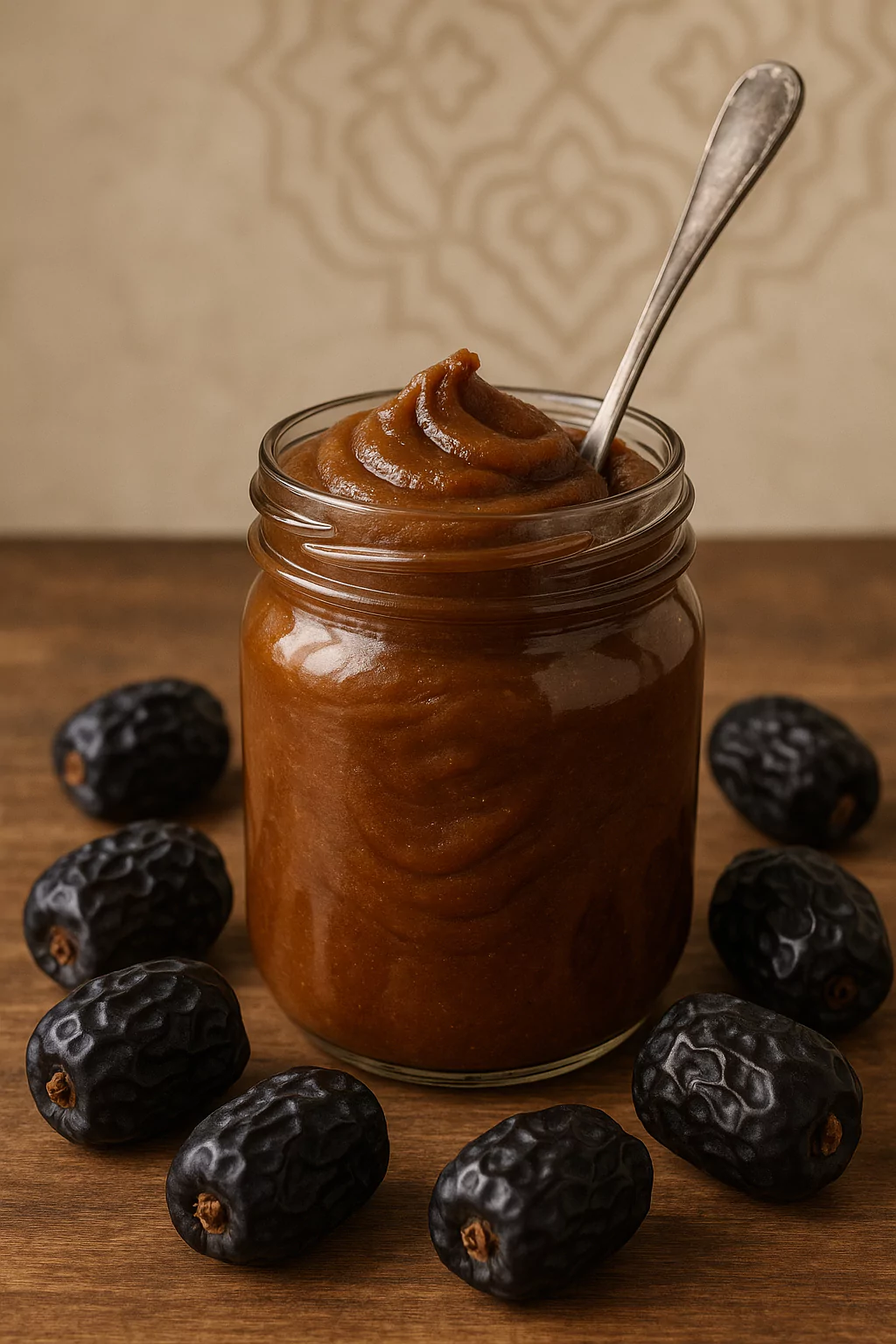
Date Paste: Natural Sugar Alternative + Easy Homemade Recipe
Date paste (معجون التمر) is a thick, smooth natural sweetener made by blending whole pitted dates with warm water. Unlike date syrup or date sugar, date paste retains every gram of fibre, minerals and antioxidants from the whole fruit — and replaces refined sugar 1:1 in any recipe. This guide covers what date paste is, its six proven health benefits, a 5-minute homemade recipe, baking substitution ratios, nutrition facts, and who benefits most.
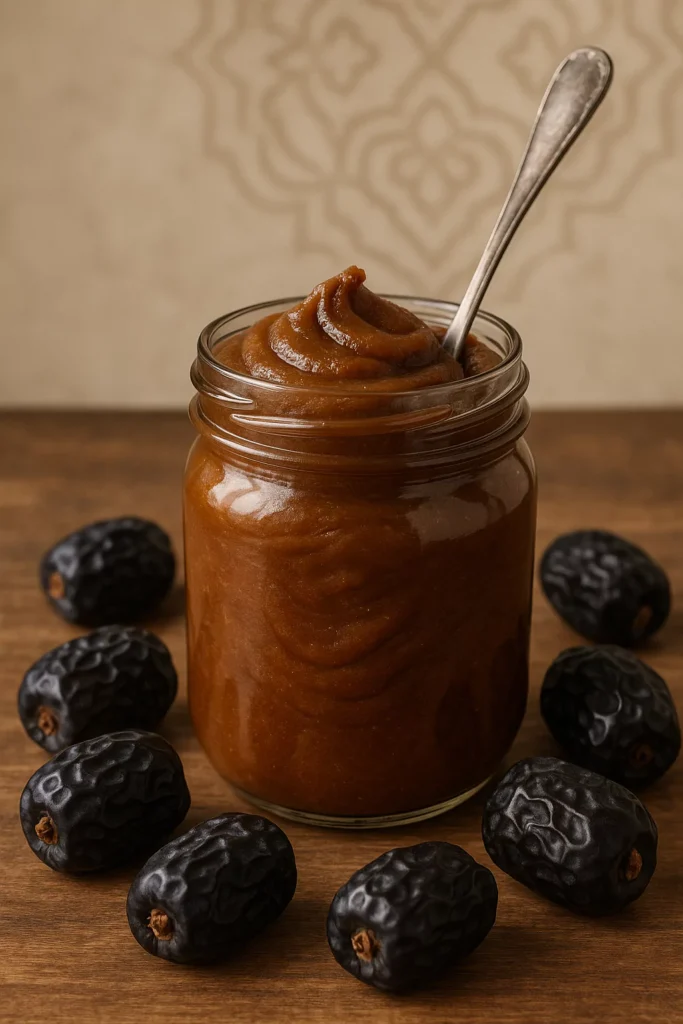
- Date paste is made by blending whole pitted dates with water — zero nutrients are removed during preparation.
- It replaces refined sugar at a 1:1 ratio by weight in virtually any recipe, from cakes to smoothies.
- The glycemic index of date paste is approximately 42–55, significantly lower than refined sugar (GI 65–100).
- Medjool and Ajwa dates produce the smoothest, richest paste with the highest antioxidant content.
- Stores for 2–3 weeks refrigerated or up to 12 months frozen — easy to make in bulk.
What Is Date Paste? (معجون التمر)
Date paste is one of the simplest and most nutritious natural sweeteners you can make. It is produced by soaking pitted dates in warm water for 10–15 minutes, then blending them into a completely smooth, thick paste. The result is a deep caramel-coloured spread with natural sweetness and a rich, toffee-like flavour that enhances both sweet and savoury dishes.
What makes date paste unique among natural sweeteners is what it keeps. Unlike date syrup, which is made by boiling and filtering, date paste contains the complete whole fruit — including all dietary fibre, soluble and insoluble, along with potassium, magnesium, calcium, iron, antioxidants, and Vitamin B6. This makes it one of the most nutritionally dense sugar alternatives available.
Any date variety can be used. Medjool dates produce the richest, most caramel-like paste. Ajwa dates from Madinah produce a slightly darker, more complex paste with the highest studied antioxidant content. Sukkari dates create an exceptionally sweet paste with a honey-like note. Deglet Noor gives a milder, neutral-flavoured paste well-suited to baking where you don’t want the date flavour to dominate.
- Contains all fibre, minerals and antioxidants of whole dates — nothing removed
- Naturally gluten-free, vegan and contains zero added ingredients when made at home
- Glycemic index approximately 42–55 — significantly lower than refined sugar (GI 65–100)
- Shelf life: 2–3 weeks refrigerated or up to 12 months frozen
- Cost: typically the cheapest date-based sweetener — make it at home in minutes
277 kcal | 75g carbohydrates | 8g fibre | 650mg potassium | 54mg magnesium | 64mg calcium | 1.5mg iron

Date Paste vs Date Syrup vs Date Sugar: What Is the Difference?
All three are made from dates, but each goes through a different preparation process that changes its texture, nutritional profile, and best uses. Understanding the differences helps you choose the right product for each recipe or health goal. Date paste is the most nutritionally complete because it uses the entire fruit with nothing removed.
| Feature | Date Paste | Date Syrup | Date Sugar |
|---|---|---|---|
| How It’s Made | Blended whole dates + water | Dates boiled; liquid extracted | Dried dates ground to powder |
| Texture | Thick, spreadable paste | Thin, pourable liquid | Fine dry powder |
| Fibre Retained? | Yes — fully intact | No — removed during extraction | Yes — partially |
| Minerals Retained? | Yes — fully | Partially | Yes — mostly |
| Best Use | Baking, spreads, smoothies | Drizzling, drinks, sauces | Baking, dry recipes |
| Sugar Replacement Ratio | 1:1 by weight | ¾ cup per 1 cup sugar | 1:1 by volume |
| Moisture It Adds | Yes — reduce other liquids by 20% | Yes — reduce other liquids | No moisture added |
| Shelf Life | 2–3 weeks fridge / 12 months frozen | 12+ months sealed | 12+ months sealed |
| Glycemic Index | ~42–55 | ~55–65 | ~55–65 |
| Cost | Cheapest (make at home) | Mid-range | Most expensive |
Which should you choose?
The right choice depends on what you’re making and what you want to achieve nutritionally. Here is a simple guide:
- For baking cakes, cookies and energy balls — date paste is best: it binds, sweetens, adds moisture, and provides the most complete nutritional profile
- For drizzling over pancakes, yogurt or porridge — date syrup is better as it pours evenly without clumping
- For dry recipes like spice rubs or granola — date sugar works without adding unwanted moisture
- For replacing sugar in smoothies and baby food — date paste is most nutritious and blends seamlessly
6 Evidence-Based Benefits of Date Paste
Date paste is far more than a sweetener — it is a concentrated source of nutrients that studies suggest may support multiple areas of health. Because it retains the entire date fruit, every tablespoon delivers fibre, potassium, magnesium, iron, antioxidants, and Vitamin B6. Here are the six most significant benefits, grounded in nutritional science.
May Support Heart Health
Date paste is rich in potassium, magnesium and antioxidants — three nutrients directly linked to cardiovascular health. Potassium may help regulate blood pressure by counteracting the effects of sodium. Magnesium supports healthy heart rhythm and vascular function. The antioxidants in dates — particularly flavonoids and phenolic acids — studies suggest may reduce oxidative stress in arterial walls and lower LDL (bad) cholesterol. A 2014 study published in the Journal of Agricultural and Food Chemistry found that Ajwa date consumption was associated with significant reductions in oxidative stress markers. Learn more about Ajwa dates for heart health.
Note: Date paste supports heart health as part of a balanced diet and is not a replacement for prescribed medication.
Improves Digestive Health
Date paste contains approximately 8g of dietary fibre per 100g — both soluble and insoluble — making it one of the most fibre-rich natural sweeteners available. Soluble fibre feeds beneficial gut bacteria and supports a healthy microbiome. Insoluble fibre adds bulk to stools and promotes regular, comfortable bowel movements. Research published in the British Journal of Nutrition has shown that regular date consumption may significantly improve stool frequency and reduce constipation without increasing intestinal pain. Just one to two tablespoons daily can support digestive comfort, reduce bloating, and help maintain a healthier gut environment over time.
Provides Natural, Sustained Energy
Date paste contains a natural blend of glucose, fructose and sucrose — three forms of sugar that the body absorbs at different rates. Unlike refined sugar, which spikes blood glucose rapidly then causes a crash, date paste delivers energy more gradually due to its high fibre content slowing absorption. This makes it particularly useful as a pre-workout snack for athletes, as a natural energy source during Ramadan fasting days, for students needing sustained mental focus, or as a mid-afternoon replacement for processed snacks. Pair it with a nut butter or yogurt to slow absorption further and extend the energy benefit. The potassium content also supports muscle function and prevents cramps during exercise.
Safe for Kids and During Pregnancy
Date paste is one of the most nutrient-appropriate sweeteners for both children and pregnant women. For pregnant women, it provides iron (supporting healthy haemoglobin levels), calcium (for bone development in the growing baby), and folate (essential for neural tube development and preventing birth defects). Studies also suggest that date consumption during late pregnancy may help support cervical ripening and reduce the need for labour augmentation — though always consult your doctor. For children, date paste is a far superior sweetener compared to refined sugar, honey (which should be avoided under 12 months), or artificial sweeteners. It can be safely introduced from weaning age in small amounts in purées, oatmeal, or as a yogurt sweetener. Read more about Ajwa dates during pregnancy.
May Enhance Brain Function and Mood
Date paste is a meaningful source of Vitamin B6 — a water-soluble vitamin that plays a direct role in neurotransmitter synthesis. Vitamin B6 is required for the production of serotonin (the mood-regulating neurotransmitter) and dopamine (the motivation and pleasure neurotransmitter). Adequate Vitamin B6 intake has been associated with improved cognitive performance, reduced symptoms of depression, and better emotional regulation in several observational studies. Beyond B6, the antioxidants in date paste may help reduce neuroinflammation, which is increasingly linked to cognitive decline. The natural sugars provide the glucose that the brain requires as its primary fuel, delivered steadily rather than in a spike, supporting concentration and mental clarity throughout the day.
Supports Skin Health from Within
The antioxidants in date paste — including flavonoids, carotenoids, and phenolic acids — may help protect skin cells from oxidative damage caused by free radicals. Oxidative stress is one of the primary drivers of premature skin aging, including fine lines, uneven skin tone, and reduced elasticity. Vitamin B6 in date paste also supports the biosynthesis of collagen-adjacent pathways. The iron content supports healthy circulation, which ensures adequate oxygen and nutrient delivery to skin cells. While date paste is not a topical skin treatment, consuming it regularly as part of a nutrient-dense diet may contribute to improved skin radiance, reduced dullness, and a slower visible aging process over time. These effects are cumulative and support overall wellbeing for women and men — see our guide on benefits of Ajwa dates for women.
Nutritional Value of Date Paste (Per 100g)
Date paste’s nutritional profile is essentially identical to whole dates, because it IS whole dates — just in paste form. No nutrients are removed during preparation. This makes it one of the most nutritionally complete natural sweeteners available, and far superior to refined white sugar which provides only empty calories with no micronutrients whatsoever.
- Energy: 277 kcal
- Carbohydrates: 75g (natural sugars)
- Dietary Fibre: 8g
- Calcium: 64mg
- Magnesium: 54mg
- Potassium: 650mg
- Iron: 1.5mg
- Vitamin B6: 0.165mg
- Antioxidants: High (flavonoids, carotenoids, phenolic acids)
Compared to white refined sugar: 0 fibre, 0 minerals, 0 vitamins, 0 antioxidants — only 400 empty kcal per 100g at a GI of 65–100.

How to Use Date Paste in Cooking and Baking
Date paste is remarkably versatile in the kitchen. It works in virtually any recipe that calls for sugar, honey, or other liquid sweeteners — but the key adjustment is accounting for the moisture it adds. The baking conversion guide below covers the most common recipes with exact ratios and liquid reduction guidance so your baked goods turn out perfectly every time.
| Recipe Type | Sugar Amount | Date Paste to Use | Liquid Reduction | Result |
|---|---|---|---|---|
| Cookies | 1 cup | 1 cup date paste | Reduce butter/oil by 2 tbsp | Chewier, denser, caramel-coloured |
| Cake | 1 cup | 1 cup date paste | Reduce milk/water by ¼ cup | Moist, dense crumb with depth of flavour |
| Brownies | 1 cup | ¾ cup date paste | No reduction needed | Fudgy, rich brownies with natural sweetness |
| Energy Balls | 2 tbsp honey/sugar | 3–4 tbsp date paste | None | Holds shape well; no baking required |
| Smoothies | 1 tbsp sugar | 1–2 pitted dates or 1 tbsp paste | None | Creamy, naturally sweet, nutritious |
| Oatmeal/Porridge | 1 tsp sugar | 1 tsp date paste | None | Rich sweetness with added fibre and minerals |
| Baby Food Purée | Any added sugar | ½–1 tsp date paste | None | Safe natural sweetener from weaning age |
| Salad Dressing | 1 tsp sugar/honey | 1 tsp date paste + warm water to thin | None | Adds body and caramel sweetness |
Why date paste changes your baking texture: Date paste adds moisture to whatever you bake. When substituting, reduce other liquid ingredients (milk, water, oil) by approximately 20% to prevent the final product being too wet or dense. For cookies, the natural sugars in dates caramelise during baking, creating an especially satisfying chewy texture that most bakers actually prefer over the refined sugar original.
How to Make Date Paste at Home (5 Minutes)
Making date paste at home is one of the simplest kitchen tasks imaginable, and the result is fresher, cheaper, and more nutritious than any commercial product. All you need is dates, warm water, and a blender. The soaking step is important — it softens the dates and makes blending effortless, producing a silkier finished paste.
Ingredients:
- 1 cup pitted dates — Medjool or Ajwa give the best flavour
- ¼ to ½ cup warm water (adjust for desired consistency)
- Optional: pinch of salt, splash of vanilla extract, or squeeze of lemon
Method:
- Check that all dates are fully pitted — remove any remaining stones completely
- Soak pitted dates in warm water for 10 to 15 minutes to soften thoroughly
- Add soaked dates and soaking water to a blender or food processor
- Blend on high for 60 to 90 seconds until completely smooth and no lumps remain
- If the paste is too thick for your purpose, add warm water one tablespoon at a time and blend again
- Transfer to a sterilised airtight glass jar
- Label with the date made and refrigerate immediately
Pro tip: For the smoothest possible paste, use very soft, fresh dates. If using drier date varieties like Deglet Noor, soak for 20–30 minutes. For a richer flavour, briefly warm the dates in a low oven (150°C / 300°F for 5 minutes) before soaking.
Storage Guide
Best Date Varieties for Paste
- Medjool — richest, creamiest, most caramel-like flavour; best for general use
- Ajwa — slightly darker, more complex flavour, highest studied antioxidant content
- Sukkari — intensely sweet, honey-like; excellent for smoothies and desserts
- Safawi — deep flavour similar to Ajwa with a slight tangy note
- Kimia — very sweet, dark, affordable; great everyday paste variety
- Deglet Noor — milder, neutral flavour; good for baking where date taste shouldn’t dominate
See our full guide on types of dates to understand which variety suits your specific recipe needs.
Traditional & Cultural Uses of Date Paste
Date paste has been a staple of traditional medicine and nutrition across the Middle East, North Africa, and South Asia for centuries. In Tibb-e-Nabawi (Prophetic medicine), dates in paste form were traditionally given to nursing mothers for postpartum recovery and iron replenishment. The Prophet Muhammad ﷺ is reported to have used dates to sweeten foods for children from birth — a tradition still followed in many Muslim families who apply a small amount of date paste (tahneek) to a newborn’s palate as a first food.
In Unani and Ayurvedic traditions, date paste has been used for building physical strength during illness recovery, supporting healthy digestion, and providing sustained energy during periods of fasting or intense physical labour. These traditional uses align directly with modern nutritional science findings about dates’ iron, fibre, mineral, and antioxidant content — confirming that centuries of cultural wisdom was nutritionally sound. Learn more about the role of dates in Islamic tradition.
🕌 Traditional Applications
- →Newborn Tahneek — date paste applied to newborn’s palate as first food; Islamic tradition
- →Postpartum Recovery — iron and energy replenishment for nursing mothers
- →Illness Recovery — building back strength naturally in Unani/Ayurvedic traditions
- →Ramadan Iftar — first food after fasting; gentle on the stomach, quick energy
- →Children’s Weaning — natural first sweet food from weaning age
- →Elderly Nutrition — easy to eat, high mineral content, supports bone health
Creative Recipes Using Date Paste
Date paste’s thick consistency and deep caramel flavour make it genuinely transformative in the kitchen. It works in ways that neither date syrup nor date sugar can match — binding dry ingredients, adding moisture, and creating a chewy richness that is unmistakably satisfying. Here are some of the most popular applications:
- No-Bake Energy Balls — mix date paste with rolled oats, almond butter, shredded coconut, and dark chocolate chips; roll into balls; refrigerate for 30 minutes
- Chocolate Stuffed Dates — fill pitted dates with date paste mixed with nut butter, then dip in melted dark chocolate
- Healthy Pancake Topping — thin date paste with a little warm water, add cinnamon and a squeeze of orange — a nutritious alternative to maple syrup
- Middle Eastern Tahini Dip — blend date paste with tahini, sesame oil, and lemon juice for a traditional sweet-savoury spread
- Avocado Date Smoothie — blend date paste with avocado, banana, almond milk, and ice for a creamy, nutritious meal
- Traditional Saudi Desserts — date paste is the foundation of many traditional Ma’amoul cookies and other Gulf sweets
- Baby Food Purée — add ½ tsp to vegetable purées from 6 months as a safe natural sweetener
Date paste pairs beautifully with nut butters, tahini, Greek yogurt, oats, cinnamon, cardamom, vanilla, dark chocolate, and fresh citrus. Combining it with protein-rich foods (nut butter, yogurt) or healthy fats slows sugar absorption — especially useful for blood glucose management.

Are There Any Side Effects of Date Paste?
Date paste is safe for most healthy adults and children when consumed in recommended amounts of 1 to 2 tablespoons daily. It is a whole food with an excellent safety profile — there are no known allergenic compounds, artificial additives, or processing chemicals when made at home. That said, like any calorie-dense food, excessive consumption can lead to some mild issues worth being aware of.
Possible Side Effects from Excessive Consumption
- Loose stools or digestive discomfort — due to very high fibre content; reduce portion if this occurs
- Increased calorie intake — at 277 kcal per 100g, large portions can contribute to weight gain if not balanced with activity
- Mild blood sugar elevation — particularly relevant for people with diabetes or insulin resistance, even though GI is lower than refined sugar
- High potassium intake — those on potassium-restricted diets (e.g. with kidney disease) should consult a doctor before regular use
For weight management, date paste is best used as a replacement for refined sugar rather than an addition to your existing diet.
People with kidney disease should consult a doctor before regular use — date paste is high in potassium (650mg per 100g) which may be contraindicated for those on potassium-restricted diets. Pregnant women should discuss portion sizes with their healthcare provider, particularly in the third trimester. Those following a low-FODMAP diet should be cautious, as dates are moderately high in fructose.
Date paste is a food, not a medicine. It does not treat, cure or prevent any medical condition. All health claims on this page are supported by nutritional science and should not replace medical advice from a qualified healthcare professional. Consult your doctor before significantly increasing date paste consumption if you have any chronic health condition.
For most healthy adults: 1–2 tablespoons daily (approximately 30–60g) provides meaningful nutritional benefits — roughly 80–160 kcal — without excessive sugar or calorie intake. This is equivalent to eating 2–4 whole dates per day.
Who Benefits Most from Date Paste?
While date paste is beneficial for almost everyone as a refined sugar replacement, certain groups gain particularly significant advantages from including it in their regular diet. Whether you are an athlete seeking natural energy, a parent looking for healthier options for your children, or someone observing Ramadan, date paste fits naturally into your nutritional needs.
Athletes & Active People
Pre/post-workout energy without processed sugar crashes. Natural glucose for fast muscle recovery. Potassium prevents cramps. Portable and easy to add to smoothies or energy balls. Explore our guide for men’s health and performance.
Pregnant Women
Iron, calcium, folate and Vitamin B6 support. Natural energy without processed sweets. Studies suggest date consumption may support labour preparation. Always consult your doctor for portion guidance. See our pregnancy guide.
Children
Natural alternative to refined sugar with real nutrients. Easy to digest. Safe from weaning age onward in small portions. Can be mixed into oatmeal, yogurt, purées and baked goods without children even noticing the substitution.
Ramadan & Fasting
Gentle first food at iftar — easy on the stomach after long fasting hours. Quick natural energy without the sudden spike of processed sweets. High nutritional density per calorie makes it especially efficient during restricted eating windows.
Vegans & Plant-Based
100% plant-based with no animal products. Replaces honey, refined sugar, and processed sweeteners. Rich in plant minerals often lacking in vegan diets — particularly iron, calcium and magnesium from a whole-food source.
Home Bakers
The most versatile natural sugar substitute available. Works 1:1 in most recipes. Adds moisture, caramel colour, chewy texture, and nutritional depth that refined sugar simply cannot provide. Explore desserts with dates for inspiration.
Frequently Asked Questions About Date Paste
Everything you need to know about date paste — answered clearly and practically, based on the most common questions from readers and home cooks.
Quick Summary
Date paste is the most nutritionally complete date-based sweetener — retaining all fibre, minerals and antioxidants of whole dates. It replaces sugar 1:1 by weight, costs almost nothing to make at home in 5 minutes, and lasts up to 12 months frozen. The best variety to use is Medjool for flavour, or Ajwa for maximum antioxidant content.
Also explore: Date Molasses · Date Sugar · Date Seed Coffee · Date Seed Powder
Explore More Date Guides
Date Paste — the most complete and nutritious way to enjoy the natural sweetness of dates. Make it at home in 5 minutes and transform your cooking, your baking, and your family’s nutrition.
More guides: Ajwa Seed Powder · Date Seed Coffee · Types of Dates · Popular Date Products
📚 Sources & References
- Al-Shahib, W. & Marshall, R.J. (2003). The fruit of the date palm: its possible use as the best food for the future? — International Journal of Food Sciences and Nutrition. PubMed
- Alkaabi, J.M. et al. (2011). Glycemic indices of five varieties of dates in healthy and diabetic subjects. — Nutrition Journal. BioMed Central
- Rahmani, A.H. et al. (2014). Therapeutic effects of date fruits (Phoenix dactylifera) in the prevention of diseases via modulation of anti-inflammatory, anti-oxidant and anti-tumour activity. — International Journal of Clinical and Experimental Medicine. PubMed
- Healthline. 8 Proven Health Benefits of Dates. Healthline.com
- USDA FoodData Central. Dates, Medjool — Nutritional Profile. USDA FDC