Ajwa Dates in Islam — Hadith, Quran, Jannah & Sunnah Guide
Everything you need to know about Ajwa dates in Islamic tradition — authentic Hadith references, Quranic context, spiritual significance, and how to follow the Sunnah practice of seven dates each morning.
Read Complete Ajwa GuideAjwa dates hold a special place in Islam because they are mentioned in authentic Hadith and are closely connected with Madinah and the Sunnah of Prophet Muhammad ﷺ. Many Muslims value Ajwa dates for their spiritual meaning, their connection with protection in Hadith, and their use as a blessed food in Islamic tradition. Understanding the religious and historical context of Ajwa dates helps us appreciate why they have remained so revered across 1,400 years of Islamic history.
In this comprehensive guide, you will learn what Islam says about Ajwa dates, the Hadith about eating seven Ajwa dates in the morning, whether Ajwa dates are mentioned in the Quran, and why Ajwa dates are considered special among Muslims worldwide. This article draws from authentic Islamic sources, scholarly interpretations, and nutritional science to provide a balanced, accurate, and faith-centered understanding of this blessed fruit. Whether you’re seeking to deepen your knowledge of Islamic tradition, explore the health benefits of Ajwa dates, or simply understand why millions of Muslims begin their day with seven dates, this guide offers clarity grounded in both faith and evidence.
Ajwa dates are the only food item specifically named by variety in authentic Hadith. While many foods are mentioned in Islamic texts, Ajwa is singled out by name — a distinction that no other date variety or food shares. This uniqueness is a key reason why Muslim scholars of Tibb-e-Nabawi (Prophetic Medicine) give them such elevated status. The precise naming in the Hadith literature demonstrates the Prophet’s ﷺ specific attention to this variety, making it not just a recommended food, but a spiritually significant practice when consumed with intention.
Why Are Ajwa Dates Special in Islam?
Ajwa dates are special in Islam because they are directly mentioned in Hadith and strongly associated with Madinah, the city of the Prophet ﷺ. They are among the most respected date varieties because of their spiritual value, their connection to the Sunnah, and their importance in Muslim culture. Unlike other foods mentioned generally in Islamic sources, Ajwa dates are specified by name in multiple authentic narrations, which gives them a unique position in Islamic dietary tradition. The Prophet Muhammad ﷺ not only consumed these dates but also recommended them specifically for their protective and healing properties, creating a living connection between modern Muslims and prophetic practice that spans over fourteen centuries.
The significance of Ajwa dates extends beyond their mention in religious texts. They represent a tangible link to the blessed land of Madinah, where the Prophet ﷺ lived, taught, and established the first Muslim community. When Muslims consume Ajwa dates, especially those sourced directly from Madinah, they participate in a practice that connects them spiritually to the Prophet’s ﷺ daily life. This spiritual dimension, combined with their documented health benefits, makes Ajwa dates a perfect example of how Islamic guidance encompasses both spiritual wellbeing and physical health in a holistic manner.
Mentioned in Hadith
Ajwa is the only date variety named specifically by the Prophet ﷺ in authenticated narrations from Sahih al-Bukhari and Sahih Muslim, Islam’s most trusted Hadith collections.
Land of Madinah
Ajwa dates grow exclusively in the blessed city of Madinah — the city of the Prophet ﷺ — giving them an unmatched geographic and spiritual connection that cannot be replicated elsewhere.
Connected to Jannah
A Hadith describes Ajwa as being from Paradise — a spiritual honor given to no other food in as direct terms in the prophetic narrations, elevating their status beyond mere nutrition.
Protection & Barakah
The Hadith links eating seven Ajwa dates in the morning to divine protection — a spiritual dimension beyond any nutritional benefit, combining faith-based practice with daily wellness.
Ramadan & Iftar
Dates have been used to break the fast since the time of the Prophet ﷺ. Ajwa is the most prestigious choice during the holy month of Ramadan, following his blessed example.
Blessed Gift
Bringing Ajwa dates from Madinah is a beloved tradition for Hajj and Umrah pilgrims — sharing the barakah (blessing) of the holy city with family and community back home.
Muslims value Ajwa dates because they combine religious significance with practical benefits. From a spiritual perspective, consuming Ajwa dates is an act of following the Sunnah — the prophetic tradition — which brings both reward and blessing. From a practical standpoint, these dates offer natural nutrition in the form of essential minerals, fiber, and energy. This dual benefit makes them ideal for multiple occasions: breaking the Ramadan fast, starting the day with energy and intention, serving guests with honor, or giving as gifts that carry both material and spiritual value. The practice of eating Ajwa dates has been maintained across generations not through obligation, but through love and reverence for the Prophet’s ﷺ guidance and the proven benefits experienced by those who follow this practice.
- Mentioned in authentic Hadith with specific protective benefits
- Strongly connected with Madinah, the city blessed by the Prophet’s ﷺ presence
- Associated with protection and blessing in multiple prophetic narrations
- Commonly eaten as part of Sunnah-inspired practice across the Muslim world
- Used during Ramadan for iftar, in daily morning routines, for gifting, and in religious gatherings
- Known for their natural sweetness, uniquely soft texture, and impressive nutritional profile
- Serve as a practical way to implement Tibb-e-Nabawi (Prophetic Medicine) in modern life
Ajwa dates should be respected for their Islamic value and consumed with proper intention, but they should not be presented as a replacement for medical care or professional treatment. They can be part of a healthy diet and a meaningful Sunnah practice when eaten in moderation and with the understanding that all healing ultimately comes from Allah. Muslims are encouraged to follow prophetic guidance while also seeking appropriate medical care when needed — these two approaches complement rather than contradict each other in Islamic understanding.
Authentic Hadith About Ajwa Dates
Ajwa dates are mentioned in several authenticated Hadith collections, with the most well-known narrations appearing in Sahih al-Bukhari and Sahih Muslim — the two most authoritative sources of Hadith in Islamic scholarship. These narrations are not casual mentions but specific recommendations from the Prophet Muhammad ﷺ regarding the consumption and benefits of Ajwa dates. The fact that these narrations appear in the “Sahih” (authentic) collections means they have passed the strictest standards of Islamic hadith verification, with unbroken chains of narration traced back to the Prophet ﷺ himself through reliable witnesses. This level of authentication gives Muslims confidence that these teachings genuinely reflect prophetic guidance and not later additions or weak traditions.
The Hadith about Ajwa dates address several key themes: protection from harm, healing properties, the specific practice of consuming seven dates in the morning, and the unique status of Ajwa dates from the Aliyah region of Madinah. These narrations are studied by Islamic scholars, nutritionists interested in prophetic medicine, and Muslims seeking to implement Sunnah practices in their daily lives. Understanding these Hadith requires both textual knowledge and scholarly interpretation, as the Arabic language and cultural context of seventh-century Arabia must be properly understood to grasp the full meaning and application of these teachings in the modern world. The table below summarizes the major authentic Hadith about Ajwa dates, providing both their meaning and their source references for those who wish to study them further.
| Topic | Hadith Meaning | Source |
|---|---|---|
| Seven Ajwa dates in the morning | Consuming seven Ajwa dates in the morning is connected with protection from poison and harmful magic for that day, as mentioned in authentic prophetic tradition. | Sahih al-Bukhari 5445, Sahih Muslim 2047 |
| Ajwa and Paradise | Ajwa is described in Hadith as having origins connected to Paradise and containing healing properties, giving it a special spiritual status. | Sunan Ibn Majah 3456 |
| Ajwa from Aliyah | Ajwa dates specifically from the Aliyah area of Madinah are mentioned in relation to healing benefits and morning consumption practice. | Sunan Ibn Majah 3455 |
These Hadith demonstrate why Ajwa dates have maintained such a special spiritual status in Islam across centuries and continents. The specificity of the guidance — naming the variety, specifying the number, mentioning the time of day, and identifying the region — shows that this was not a general encouragement to eat healthy food, but a particular prophetic recommendation with specific application. Many Muslims eat Ajwa dates in the morning because of this Sunnah connection, viewing it as both a religious practice and a way to start the day with barakah (blessing). The practice has been maintained not through religious compulsion but through voluntary devotion, as Muslims seek to emulate the Prophet’s ﷺ lifestyle in all its details, from major acts of worship to daily eating habits.
It’s important to approach these Hadith with both faith and understanding. While Muslims believe in the protective and healing properties mentioned in these narrations, this belief is held within the broader Islamic framework that all benefit comes ultimately from Allah, and that prophetic guidance works in harmony with — not in replacement of — sound medical practice. The seven-date practice is seen as a prophetic prescription that may support health and wellbeing when undertaken with proper intention (niyyah), but it does not negate the responsibility to seek professional medical care when seriously ill. This balanced approach reflects the holistic nature of Islamic guidance, which integrates spiritual, physical, and practical dimensions of human life.
Verification is essential: Always verify exact Arabic wording and Hadith grading from trusted Islamic sources or qualified scholars before quoting religious text in detail. Hadith numbers may vary slightly between different editions and compilations of the same collection. For spiritual and religious matters, consultation with knowledgeable scholars who can provide proper context and interpretation is highly recommended, especially when applying Hadith to specific life situations or health decisions.
What Is the Hadith About Seven Ajwa Dates?
The famous Hadith about Ajwa dates specifically mentions eating seven Ajwa dates in the morning on an empty stomach. This Hadith is commonly understood by Islamic scholars as a sign of Ajwa’s special blessing and protective value in Islamic tradition. The narration appears in multiple authentic sources with slight variations in wording but consistent core meaning. What makes this Hadith particularly significant is its specificity — it doesn’t simply recommend “eating dates” or even “eating Ajwa dates,” but provides an exact number (seven) and an optimal time (morning). This level of detail suggests deliberate prophetic guidance meant to be followed precisely rather than interpreted broadly, which is why millions of Muslims worldwide have maintained this practice for over 1,400 years.
The practice of eating seven dates in the morning has both spiritual and practical dimensions. From a spiritual perspective, it represents obedience to prophetic guidance and trust in the wisdom of the Prophet Muhammad ﷺ, who did not speak from personal opinion but was guided by divine revelation. From a practical standpoint, modern nutritional science has discovered that this practice provides an ideal morning intake of natural sugars for energy, dietary fiber for digestion, potassium for heart and muscle function, and antioxidants for cellular health — all delivered in an easily digestible, natural food that breaks an overnight fast gently. The convergence of ancient prophetic wisdom and modern nutritional science is seen by many Muslims as evidence of the timeless relevance of Islamic guidance when properly understood and applied.
“He who eats seven Ajwa dates every morning will not be affected by poison or magic on the day he eats them.”
“Ajwa dates are from Jannah (Paradise) and they contain healing for poison.”
“Ajwa dates from the Aliyah region of Madinah contain healing properties and serve as an antidote in the morning.”
Because of these Hadith, many Muslims eat seven Ajwa dates in the morning as a Sunnah-inspired practice that has been transmitted from generation to generation. The practice is particularly common during Ramadan, when breaking the fast with dates follows the Prophet’s ﷺ example, but dedicated practitioners maintain it year-round as a daily spiritual and nutritional routine. However, this practice should be understood with proper respect, balance, and scholarly guidance. Ajwa dates are blessed and nutritious, carrying both spiritual significance and practical benefit, but they should not be used as a replacement for medical treatment when someone is ill or as a superstitious charm divorced from proper Islamic understanding of divine will and causation.
Islamic scholars explain that the protective benefit mentioned in the Hadith operates within the framework of tawakkul (reliance on Allah) and adhering to prophetic guidance with sincere intention. The protection is not magical or automatic, but represents a divinely ordained connection between following prophetic practice and receiving divine favor. This understanding prevents both excessive skepticism that dismisses prophetic wisdom and naive literalism that might neglect other responsibilities. The practice of eating seven Ajwa dates daily should be seen as one element of a holistic Islamic lifestyle that includes prayer, ethical conduct, community responsibility, and appropriate action in all matters including health care. When approached with this balanced understanding, the seven-date practice becomes a meaningful daily touchstone connecting faith, health, and prophetic love.
Following the seven-date Sunnah with proper intention (niyyah) transforms a simple act of eating into an act of worship (ibadah). Before eating your Ajwa dates each morning, make the conscious intention to follow the Prophet’s ﷺ guidance and seek Allah’s protection and blessing — this spiritual dimension is what makes the practice truly meaningful. Begin with Bismillah (In the name of Allah), eat with your right hand as per Sunnah, consume all seven dates before other food or drink, and follow with water. Many scholars recommend pairing this practice with Fajr prayer time for maximum spiritual benefit and as an energizing start to your day.
Are Ajwa Dates Mentioned in the Quran?
Ajwa dates are not mentioned by name in the Quran. However, dates (tamr) and date palms (nakhl) are mentioned in the Quran in several significant places, establishing dates as a blessed food with divine favor. This distinction is important for accurate Islamic knowledge: while the Quran speaks generally of dates and establishes their status as one of Allah’s blessings for humanity, it is the Hadith that specifically name Ajwa dates and provide detailed guidance about their particular benefits and recommended consumption. Understanding this distinction helps prevent the common confusion where some people mistakenly believe the Quran specifically mentions Ajwa dates, while others wrongly assume dates have no Quranic significance at all. The truth lies in between: dates in general have strong Quranic endorsement, while Ajwa specifically derives its special status from authentic Hadith.
The Quranic references to dates and date palms establish several important principles. First, they identify dates as one of the primary blessings Allah has provided for human sustenance. Second, they connect dates with significant prophetic moments, particularly in the birth narrative of Prophet Isa (Jesus, peace be upon him) where Maryam (Mary) is divinely commanded to eat dates. Third, they establish date palms as one of the signs of Allah’s creative power and mercy. These Quranic themes create the broader theological and nutritional context within which the specific Hadith about Ajwa dates should be understood. The Quran establishes dates as blessed; the Hadith identify Ajwa as particularly significant within that broader category; and together they form a complete picture of this fruit’s importance in Islamic tradition and practice.
“And shake toward yourself the trunk of the palm tree; it will drop upon you ripe, fresh dates.”
Allah commanded Maryam (peace be upon her) to eat dates during the birth of Prophet Isa (peace be upon him). This verse is one of the most powerful Quranic endorsements of dates as beneficial food, particularly in contexts requiring physical strength and recovery. Modern medical research has since confirmed that dates contain compounds that may support uterine health and labor — a remarkable alignment of divine guidance and contemporary science that strengthens believers’ trust in Quranic wisdom. This verse is often cited in discussions about dates during pregnancy and postpartum recovery.
“And We brought forth for you thereby gardens of date-palms and grapevines in which for you are abundant fruits and from which you eat.”
Allah mentions date palms alongside grapevines as signs of His provision and blessing for humanity. The specific mention of date palms before grapes in this verse indicates their importance in the Arabian context and Islamic civilization more broadly. This verse establishes dates as one of the favored foods mentioned in the Quran as a divine gift to be consumed with gratitude and moderation. The Quran frequently uses agricultural imagery, particularly dates and olives, to illustrate Allah’s creative power and sustaining mercy toward human beings.
Additional Quranic references to date palms appear in verses describing Paradise (Jannah), where date palms are mentioned as part of the blessed gardens promised to the righteous. This creates a symbolic and spiritual connection between dates in this world and the eternal blessings of the hereafter. When combined with the Hadith describing Ajwa dates specifically as being “from Paradise,” this Quranic imagery gives dates — and especially Ajwa dates — a unique position as a food that connects the earthly and heavenly realms in Islamic consciousness. This is not mere symbolism; for believers, consuming dates with awareness and gratitude becomes a reminder of ultimate return to Allah and the eternal gardens He has promised to the faithful.
So the accurate and scholarly answer to whether Ajwa dates appear in the Quran is nuanced and requires careful statement:
- The Quran mentions dates (tamr) and date palms (nakhl) in general terms as blessed foods and signs of Allah’s mercy
- Authentic Hadith specifically mention Ajwa dates by name with detailed guidance about their benefits and consumption
- Ajwa dates are respected because of their specific mention in Hadith combined with the Quran’s general endorsement of dates
- The spiritual significance of Ajwa comes from both its Quranic category (blessed food) and its Hadith specification (named variety with special properties)
- Proper Islamic understanding requires distinguishing between what the Quran states directly and what is established through authentic Hadith
- Both sources work together to establish the complete Islamic perspective on Ajwa dates and their significance
This distinction is important because accuracy in attributing religious knowledge is a fundamental Islamic principle. Some people confuse Quranic references to dates in general with specific references to Ajwa, leading to incorrect claims that “Ajwa dates are mentioned in the Quran by name.” Others, seeking to correct this error, sometimes go too far in the opposite direction and minimize the genuine Quranic foundation for valuing dates. The balanced, scholarly position recognizes that Ajwa dates derive their special status primarily from authentic Hadith, while the broader category of dates receives Quranic endorsement — and both sources together, Quran and Sunnah, establish the complete Islamic understanding of this blessed fruit and its role in Muslim life and practice.
Are Ajwa Dates from Jannah (Paradise)?
A Hadith describes Ajwa dates as being from Paradise (Jannah), and Islamic scholars commonly understand this as a sign of their blessing, honor, and special spiritual status rather than a literal botanical claim about their physical origin. This narration has led to Ajwa dates being viewed as having a connection to Paradise that no other earthly food shares in such direct terms. The concept requires proper theological understanding: while Ajwa date palms physically grow in Madinah using normal agricultural processes, the description of them as “from Paradise” communicates their elevated spiritual rank and divine blessing. This type of attribution is not unique in Islamic tradition — Zamzam water, the Black Stone of the Kaaba, and certain other blessed objects are similarly described as having heavenly connections while existing in earthly form.
The scholarly interpretation of this Hadith emphasizes the spiritual and symbolic dimensions rather than botanical literalism. When the Prophet ﷺ described Ajwa dates as being from Paradise, he was communicating several layered meanings: their exceptional blessing among foods, their special divine favor, their connection to the sacred geography of Madinah (which itself has a spiritual connection to Paradise), and their role in prophetic medicine and protection. This multidimensional meaning is characteristic of prophetic speech, which often operates on both literal and spiritual levels simultaneously. For believers, consuming Ajwa dates with this understanding becomes an act of tasting a fruit that carries heavenly blessing into earthly life — a reminder of the ultimate destination and the divine mercy that provides sustenance in both worlds.
“Ajwa dates are from Paradise, and they contain healing for poison.”
Contemporary Islamic scholars and experts in Tibb-e-Nabawi (Prophetic Medicine) explain this narration by drawing parallels with other blessed objects in Islamic tradition. Just as Zamzam water springs from the earth through natural geological processes yet carries special blessing traced to divine intervention in the story of Hajar and Ismail (peace be upon them), Ajwa date palms grow through natural botanical processes yet carry special blessing traced to their prophetic endorsement and potential heavenly origin. The “from Paradise” attribution doesn’t contradict natural agricultural reality; rather, it adds a spiritual dimension to the physical reality, creating a holistic understanding that encompasses both material and metaphysical aspects of these blessed dates.
Islamic scholars of Tibb-e-Nabawi explain that describing Ajwa as “from Jannah” communicates their elevated spiritual rank — similar to how Zamzam water is from this world but carries a divine blessing beyond its physical properties. It is a statement of honor and barakah (blessing), not necessarily a literal claim about botanical transportation from the heavenly realm. Some scholars suggest the first Ajwa palm may have been brought from Paradise and then propagated naturally in Madinah, while others understand it as metaphorical language indicating supreme blessing. Both interpretations recognize the special status of these dates while maintaining consistency with Islamic principles of natural law and divine intervention.
Ajwa dates physically grow in this world, especially in Madinah, Saudi Arabia, where they have been cultivated for over fourteen centuries. Modern agricultural science has studied their cultivation, soil requirements, and growing conditions, finding them to be a natural variety of date palm adapted to Madinah’s climate and environment. This scientific reality doesn’t diminish their religious significance; rather, it demonstrates how divine blessing can work through natural means. The fact that Ajwa dates can only be successfully grown in Madinah and its immediate surroundings — attempts to cultivate them elsewhere typically fail to produce the same quality or characteristics — is seen by many believers as evidence of the special blessing associated with the blessed land where the Prophet ﷺ lived and where these dates are “from Paradise” in their unique spiritual reality.
For practicing Muslims, the theological and practical importance of understanding Ajwa dates as “from Paradise” lies not in botanical curiosity but in spiritual consciousness. When consumed with awareness of their blessed origin and prophetic endorsement, Ajwa dates become more than nutrition — they become a means of connection to prophetic guidance, divine mercy, and ultimate return to Paradise. This consciousness transforms the daily practice of eating dates into an act of remembrance (dhikr) and anticipation of eternal reward, making even a simple breakfast into an opportunity for spiritual growth and gratitude to Allah for His countless blessings, both earthly and heavenly.
This is one reason many Muslims consider Ajwa dates the most blessed of all date varieties, and why they are willing to pay premium prices for authentic Madinah Ajwa compared to other date types. The value is not purely in the taste or texture, though these are excellent, but in the spiritual connection, prophetic endorsement, and association with Paradise that makes these dates uniquely precious in Islamic consciousness and practice across cultures and continents.
Ajwa Dates and Madinah
Ajwa dates are inseparably connected with Madinah al-Munawwarah (the Enlightened City), one of the three holiest cities in Islam and the city where Prophet Muhammad ﷺ established the first Muslim community after the Hijrah (migration) from Makkah. Madinah is famous worldwide for producing the highest quality Ajwa dates, and the connection between this blessed fruit and this blessed city creates a powerful spiritual and commercial relationship that has persisted for over fourteen centuries. For millions of Muslims who visit Madinah during Hajj, Umrah, or dedicated ziyarah (visitation), purchasing authentic Ajwa dates to bring home is not merely shopping — it is a religious practice, a way of carrying the barakah (blessing) of Madinah back to family and community, creating a tangible connection between those who visit the sacred city and those who remain at home.
The unique relationship between Ajwa dates and Madinah operates on multiple levels: agricultural, historical, spiritual, and economic. Agriculturally, the soil, climate, and water of Madinah create conditions in which Ajwa date palms thrive in ways they cannot elsewhere — attempts to transplant Ajwa cultivation to other regions, even within Saudi Arabia, typically produce inferior results. Historically, dates were the primary food source of Madinah during the Prophet’s ﷺ time, forming the economic backbone of the city and feeding the early Muslim community through times of hardship and blessing alike. Spiritually, the Prophet’s ﷺ personal involvement in date cultivation — he is reported to have planted date palms himself — and his specific endorsement of Ajwa dates creates a living connection between modern Muslims and prophetic practice when they consume dates from the same blessed land.
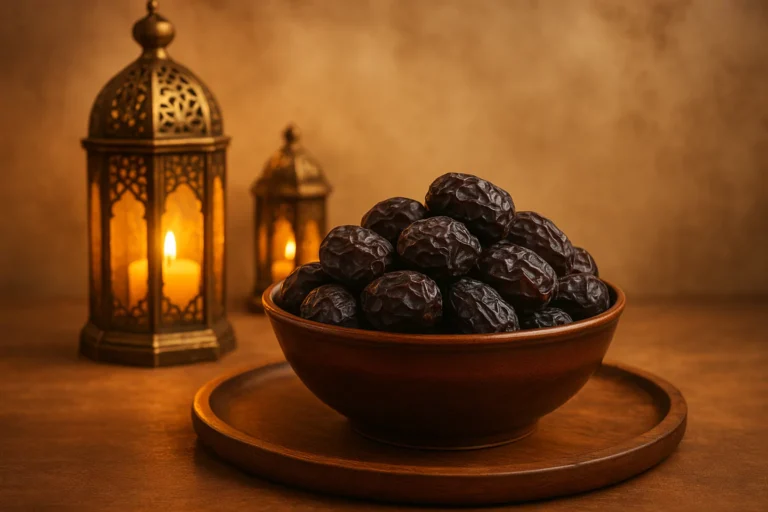
Madinah’s date markets are a destination for pilgrims and visitors, offering various grades and qualities of Ajwa dates. The most prized are those from the Aliyah farms mentioned in Hadith, though all authentic Madinah Ajwa carries significance. Understanding quality markers helps consumers identify genuine Ajwa: they should be medium-sized, dark brown to black in color, with fine white lines on the surface, soft texture, natural sweetness without artificial enhancement, and most importantly, clear documentation of Madinah origin. Packaging should specify “Al-Madinah Al-Munawwarah” as the source, ideally with specific farm or region identification. Prices reflect the genuine scarcity and spiritual significance of authentic Ajwa dates, with premium quality typically ranging from $25 to $50 per kilogram, sometimes higher for the most select grades from historically significant farms.
When purchasing Ajwa dates, always look for packaging that specifically states “Madinah, Saudi Arabia” or “Al-Madinah Al-Munawwarah” as the origin. Authentic Ajwa can only be grown in Madinah and its immediate surroundings — dates labeled simply “Ajwa” without clear origin verification may not be genuine or may be lower-quality imitations. Reputable sellers often provide farm names, harvest dates, and quality certifications. The premium price of authentic Madinah Ajwa (typically $30-50/kg) reflects their genuine scarcity and spiritual significance. When in doubt, purchase from established vendors near Masjid al-Nabawi or from recognized Islamic retailers with verified supply chains. For those unable to visit Madinah, seeking recommendations from recent pilgrims or trusted Islamic organizations can help identify reliable sources. Learn more about Ajwa dates pricing and authenticity.
The gifting tradition surrounding Madinah Ajwa dates is deeply rooted in Islamic culture and social practice. When pilgrims return from Hajj or Umrah, distributing Ajwa dates among family, friends, and community members is a common and beloved practice. This is not mere souvenir-giving but a spiritual act of sharing barakah (blessing) — the dates carry both the blessing of the holy land and the love of the giver who thought of their community while in the sacred city. This practice strengthens community bonds, enables those who could not make pilgrimage to partake in its blessings indirectly, and keeps the consciousness of Madinah alive in Muslim communities worldwide. Many Muslims specifically request Ajwa dates as the preferred gift from Madinah, valuing them above commercial souvenirs or other date varieties because of their unique prophetic significance.
Madinah’s date agriculture has modernized significantly while maintaining traditional reverence for this blessed crop. Contemporary farms use advanced irrigation, quality control, and packaging techniques to ensure Ajwa dates reach global markets in optimal condition. The Saudi government has implemented certification systems to protect the authenticity and reputation of Madinah dates, recognizing their religious significance and economic value. Despite modernization, the spiritual dimension remains central: many date farmers in Madinah view their work as a religious service, providing the Ummah with the blessed fruit mentioned in Hadith and maintaining an agricultural tradition traced back to the Prophet ﷺ himself. This fusion of commercial enterprise and religious consciousness makes Madinah’s date industry unique, operating simultaneously as agriculture, spiritual service, and cultural preservation.
Ajwa Dates in Islamic History
Dates were an absolutely essential food in the life of Prophet Muhammad ﷺ and the early Muslim community (Ummah), serving roles far beyond basic nutrition. In the seventh-century Arabian context, dates were currency, military rations, trade goods, famine relief, guest hospitality, and daily sustenance all in one versatile, preservable form. The Prophet ﷺ and his Companions often relied on dates and water alone for sustenance during times of scarcity, demonstrating both the nutritional completeness of dates and the simplicity of early Islamic lifestyle. Understanding this historical context helps modern Muslims appreciate why dates — and especially Ajwa dates — hold such significance in Islamic tradition and why their consumption is considered an act of connecting with prophetic heritage rather than merely following a dietary recommendation.
Ajwa dates became specifically distinguished because of the prophetic Hadith mentioning them by name, but their cultivation in Madinah predates Islam and continued through Islamic history with increasing reverence. The Ansaar (the helpers, the original Muslim inhabitants of Madinah) were predominantly date farmers, and their date palm orchards formed the economic foundation that supported the Prophet’s ﷺ community during the crucial early years of Islam in Madinah. The Prophet ﷺ himself participated in date cultivation, planting palms and teaching companions agricultural practices — a demonstration of Islam’s holistic approach to life that values both spiritual devotion and productive work. This prophetic example elevated date farming from mere agriculture to a practice imbued with religious meaning and barakah.
The Prophet ﷺ is reported in authentic narrations to have personally planted and cultivated date palms in Madinah, teaching his Companions the practices of date agriculture while emphasizing the spiritual reward of planting beneficial trees. The Ansaar (Helpers who welcomed Muslims to Madinah) were skilled date farmers whose orchards fed the growing Muslim community and provided economic stability during the early vulnerable years. Dates served as currency in early Islamic commerce, as rations for military campaigns, as zakah (charity) payments, and as hospitality offerings — they were woven into every aspect of early Islamic society. This multifaceted role explains why dates feature so prominently in Islamic texts, law, and tradition, far beyond their role as simply another food item.
Throughout Islamic history, Ajwa dates maintained their special status across changing dynasties, expanding empires, and diverse cultures. As Islam spread beyond Arabia to Persia, North Africa, South Asia, and eventually worldwide, Muslims carried with them the knowledge of Ajwa dates’ special significance even in regions where dates couldn’t be grown. The practice of eating seven dates in the morning, preferably Ajwa when available, became a recognizable element of Islamic practice across cultures. When other date varieties were more accessible, Muslims still sought Ajwa specifically for special occasions, religious observances, and breaking Ramadan fasts, often paying premium prices for imported Madinah dates. This persistence across geography and time demonstrates the deep cultural and religious embedding of Ajwa dates in Islamic consciousness.
The historical connection between dates and Islamic worship practices also reinforced their significance. Breaking the Ramadan fast with dates follows the Prophet’s ﷺ explicit example and instruction, making dates an integral part of the most important month in the Islamic calendar. The Prophet ﷺ would break his fast with fresh dates (rutab), and if unavailable, dried dates (tamr), and if those were unavailable, with water. This established a clear preference hierarchy that Muslims have maintained for fourteen centuries, with Ajwa dates being the most prized choice when available. The moment of iftar (fast-breaking) thus becomes not just a meal but a reenactment of prophetic practice, with each date carrying the weight of tradition and the sweetness of following beloved Sunnah.
In Islamic medical tradition (Tibb-e-Nabawi), Ajwa dates occupied a special position among the foods and remedies discussed by scholars. Classical Islamic physicians and scholars such as Ibn Qayyim al-Jawziyya, who wrote extensively on Prophetic Medicine, gave particular attention to Ajwa dates because of their mention in authentic Hadith. These scholars attempted to understand the medical wisdom behind the prophetic recommendation, discussing the dates’ effects on various bodily systems, their use in treating specific conditions, and their general strengthening properties. This scholarly tradition created a bridge between religious devotion and medical inquiry, demonstrating that faith and reason, revelation and observation, could work together in understanding beneficial practices — an approach that modern Muslims continue when they explore how prophetic dietary guidance aligns with contemporary nutritional science.
Today, Ajwa dates remain popular during Ramadan, Hajj, Umrah, Islamic gifting occasions, weddings, religious celebrations, and daily Sunnah-inspired eating. The tradition has not only survived but thrived in the modern era, with global Muslim markets for Ajwa dates, international shipping making authentic Madinah dates available worldwide, and renewed interest among young Muslims in reviving Sunnah practices including dietary traditions. Social media, Islamic educational platforms, and health-conscious Muslim communities have created new visibility for Ajwa dates and the seven-date morning practice, introducing classical traditions to contemporary audiences in ways that resonate with both spiritual seekers and health enthusiasts. This modern renaissance demonstrates the enduring relevance of prophetic guidance when it addresses timeless human needs — in this case, the need for wholesome nutrition, spiritual connection, and practical daily practices that integrate faith into ordinary life. For more information about different types of dates valued in Islamic tradition, explore our comprehensive guide.
Ajwa Dates, Nutrition and Prophetic Medicine
Ajwa dates are valued in Islamic tradition for their spiritual significance, but they also provide substantial natural nutrition that aligns remarkably with modern dietary science. Like other date varieties, Ajwa dates contain natural carbohydrates for energy, dietary fiber for digestive health, potassium for heart and muscle function, magnesium for bone health and metabolic processes, iron for blood health, B-vitamins for energy metabolism, and powerful antioxidants including flavonoids and phenolic compounds. What makes Ajwa dates particularly interesting from a nutritional perspective is that some research suggests they may have higher concentrations of certain beneficial compounds compared to other date varieties, though more research is needed to fully confirm and quantify these differences. The convergence of traditional Islamic endorsement and modern nutritional validation creates a compelling case for incorporating Ajwa dates into a balanced diet.
These nutrients can support daily energy levels throughout the day, digestive regularity and gut health, cardiovascular function and blood pressure regulation, bone density and skeletal health, blood sugar management when consumed in appropriate portions, and general wellness through antioxidant protection against cellular damage. However, it is crucial to maintain balance and avoid exaggerated claims: Ajwa dates should not be described as a guaranteed cure for disease or a replacement for medical treatment. The Islamic approach to Ajwa dates recognizes them as both blessed and beneficial, combining spiritual value with practical nutrition, but always within the framework that Allah is the ultimate healer and that professional medical care should be sought when needed. This balanced understanding respects both the prophetic endorsement of Ajwa dates and the Islamic principle of taking appropriate worldly means for health and wellbeing.
A balanced way to understand Ajwa dates nutritionally and spiritually is through these complementary perspectives:
- Islam gives Ajwa dates special spiritual value through authentic Hadith and their connection to Madinah and the Prophet ﷺ
- Nutrition science confirms that Ajwa dates provide valuable natural nutrients including fiber, minerals, vitamins, and antioxidants
- Hadith give Ajwa dates unique religious importance as the only food variety specifically named in prophetic narrations with protective benefits
- Medical issues should always be discussed with qualified healthcare professionals rather than relying solely on any food, however blessed
- The seven-date morning practice provides meaningful amounts of key nutrients at an optimal time for absorption and energy
- Consuming Ajwa dates with proper intention (niyyah) combines physical nutrition with spiritual practice and reward
- Modern research on dates’ health benefits validates traditional knowledge while remaining appropriately cautious about specific disease claims
Scholars of Tibb-e-Nabawi (Prophetic Medicine) note that the Prophet’s ﷺ guidance on eating seven Ajwa dates in the morning aligns remarkably with modern nutritional science — this amount provides meaningful doses of dietary fiber (supporting digestive health and blood sugar regulation), potassium (essential for heart and muscle function), magnesium (crucial for bone health and hundreds of enzymatic reactions), natural sugars for immediate energy, and protective antioxidants, all at the start of the day when nutrient absorption is most efficient and when the body needs fuel to break an overnight fast. Faith and science converge here in a beautiful way, demonstrating that divine guidance, when properly understood, addresses human needs holistically. This convergence strengthens believers’ trust in prophetic wisdom while offering health-conscious individuals practical benefits grounded in both tradition and research.
The practice of Tibb-e-Nabawi (Prophetic Medicine) in contemporary Islamic scholarship seeks to understand the health wisdom in prophetic guidance while avoiding both naive literalism and excessive skepticism. Regarding Ajwa dates, this balanced approach recognizes that the Prophet’s ﷺ recommendation likely had both spiritual and physical dimensions — the spiritual protection mentioned in Hadith operates through divine will and is accessed through faith and obedience, while the nutritional benefits operate through the natural properties Allah created in these fruits. Both dimensions are real and complementary rather than contradictory. Modern Muslims can thus benefit from Ajwa dates on multiple levels: as an act of worship following Sunnah, as a nutritious whole food supporting physical health, and as a daily touchstone connecting contemporary life with prophetic example.
Contemporary research has examined various health aspects of date consumption, with studies published in peer-reviewed journals exploring their effects on cardiovascular markers, blood sugar regulation, digestive health, antioxidant status, bone health, and more. While much of this research studies dates generally rather than Ajwa specifically, the findings provide scientific context for understanding why dates have been valued nutritionally across millennia. Some preliminary research has specifically examined Ajwa dates and suggested they may have particularly high antioxidant content and specific bioactive compounds, though more rigorous, large-scale human studies are needed before definitive health claims can be made. This represents an area where traditional Islamic knowledge and modern science can work together productively — Islamic tradition provides centuries of observational evidence of benefit, while scientific methodology can help identify mechanisms, optimal dosages, and specific applications, creating a fuller understanding that serves both faith and health. For comprehensive information on Ajwa dates’ health benefits, explore our evidence-based guide.
How to Eat Ajwa Dates According to Sunnah
The most well-known Sunnah practice regarding Ajwa dates is eating seven dates in the morning on an empty stomach, based on the authentic Hadith previously mentioned. This practice combines specific elements that, when followed correctly, transform simple eating into an act of worship (ibadah): proper intention (niyyah), correct number (seven dates), optimal timing (morning, preferably before other food), use of the right hand (following general Sunnah of eating), and beginning with Bismillah (in the name of Allah). Many Muslims follow this practice because of its clear spiritual meaning and direct connection with the Sunnah of Prophet Muhammad ﷺ. While not an obligatory religious requirement, it represents a recommended practice (mustahabb) that carries reward when done with proper intention and brings both spiritual benefit through following Sunnah and potential physical benefit through the nutritional value of the dates themselves.
The practice should be understood not as a magical ritual but as a meaningful prophetic prescription operating within the framework of Islamic understanding of divine will, natural law, and spiritual benefit. The protection mentioned in the Hadith is granted by Allah in response to following prophetic guidance with sincerity, not through any inherent magical property of the dates themselves. This understanding prevents both superstitious approaches that treat Ajwa dates as charms divorced from proper Islamic theology, and overly reductionist approaches that see them as merely nutritious food with no spiritual dimension. The balanced Islamic view recognizes both material and spiritual realities, understanding that Allah works through both natural means (the nutritional properties of dates) and divine favor (the blessing of following prophetic guidance with faith and intention).
Common ways Muslims incorporate Ajwa dates into religious and daily practice include:
- Eating seven Ajwa dates in the morning on an empty stomach as the primary Sunnah practice, ideally after Fajr prayer and before breakfast
- Breaking the Ramadan fast (iftar) with dates and water, following the Prophet’s ﷺ example, with Ajwa being the preferred variety when available
- Eating Ajwa dates as a Sunnah-inspired daily food beyond the morning practice, incorporating them into meals, snacks, or desserts
- Giving Ajwa dates as gifts from Madinah to family, friends, and community members after Hajj or Umrah, sharing the blessing of the holy city
- Serving Ajwa dates to guests as an expression of Islamic hospitality and sharing blessed food with visitors
- Using Ajwa dates in traditional Islamic desserts and recipes during Ramadan, Eid celebrations, and other special occasions
- Consuming them in moderation as part of a balanced, healthy diet consistent with Islamic principles of dietary moderation and avoiding excess
- Pairing dates with other Sunnah foods such as milk, creating combinations mentioned in prophetic traditions
For the complete Sunnah experience when following the seven-date morning practice: First, make the intention (niyyah) in your heart to follow the Prophet’s ﷺ guidance and seek Allah’s protection and blessing through this practice. Begin with Bismillah (In the name of Allah) as you start eating. Eat with your right hand, as this is the general Sunnah for all eating and drinking. Consume all seven Ajwa dates before eating or drinking anything else, on an empty stomach for maximum benefit. Follow with a glass of water, as hydration complements the fiber content of dates. Many scholars recommend doing this practice shortly after Fajr prayer as the optimal “morning” timing mentioned in Hadith, making it both a spiritual and energizing start to your day. Maintain this as a daily practice rather than sporadic adherence, as consistency transforms acts into established worship and allows cumulative benefits over time.
Ajwa dates are naturally sweet and calorie-dense due to their concentrated natural sugar content, so portion control is important for overall dietary balance. People with diabetes should monitor blood sugar responses carefully and consult healthcare providers about appropriate portions and timing. Those with kidney disease should be aware of the potassium content and discuss consumption with their nephrologist. Individuals following calorie-restricted diets for weight management should account for dates’ significant caloric contribution (approximately 20-25 calories per date). While dates are nutritious, they should be part of a varied, balanced diet rather than consumed in excessive quantities. The Sunnah practice of seven dates daily is within reasonable limits for most healthy adults, but individual health conditions may require modification — always prioritize medical advice for personal health decisions while respecting religious practices.
The spiritual etiquette (adab) of consuming Ajwa dates extends beyond the physical act of eating to encompass gratitude, mindfulness, and consciousness of Allah’s blessing. Before eating, Muslims are encouraged to reflect briefly on the barakah (blessing) of these dates — their prophetic endorsement, their connection to Madinah, their role in Islamic history, and the divine mercy that provides such wholesome sustenance. During eating, maintaining presence and avoiding distraction honors the practice and enhances both spiritual and physical benefit. After eating, expressing gratitude to Allah (Alhamdulillah – all praise belongs to Allah) completes the cycle of blessing, turning consumption into worship. This mindful approach transforms a simple act of eating into an integrated spiritual experience that nourishes body, heart, and soul simultaneously — precisely the holistic approach characteristic of Islamic practice when properly understood and implemented.
How Many Ajwa Dates Should You Eat Daily?
The most well-known number connected with Ajwa dates in Hadith is seven dates consumed in the morning, which represents the primary Sunnah-based recommendation for those following this prophetic practice. For general daily consumption outside of this specific Sunnah practice, the appropriate amount depends on several individual factors: overall health status, dietary goals (weight maintenance, loss, or gain), physical activity level, presence of medical conditions such as diabetes or kidney disease, total daily caloric intake, and consumption of other sweet or carbohydrate-rich foods. Unlike the specific religious practice of seven dates in the morning, general date consumption should be tailored to individual circumstances and ideally discussed with healthcare providers for those with specific health concerns.
Islamic dietary principles emphasize moderation (wasatiyyah) in all matters, including consumption of beneficial foods. Even foods endorsed in religious texts should be consumed reasonably rather than excessively, as Islam warns against wasteful excess in all aspects of life. The Quran instructs believers to “eat and drink but waste not by excess” (7:31), a principle that applies even to blessed foods like Ajwa dates. This Islamic framework of moderation aligns with modern nutritional science, which recognizes that even nutritious whole foods should be consumed as part of a varied, balanced diet rather than in amounts that displace other necessary foods or provide excessive calories. The seven-date morning practice falls well within moderate limits for most people, but adding large quantities of dates beyond this throughout the day might create imbalance for some individuals.
| Purpose/Context | Suggested Daily Intake | Notes |
|---|---|---|
| Sunnah practice (morning) | 7 Ajwa dates on empty stomach | Primary prophetic recommendation from authentic Hadith |
| General healthy snacking | 2–4 dates | Provides energy and nutrients without excessive calories |
| Weight management | 1–2 dates | Satisfies sweet cravings with whole food nutrition |
| Diabetes/blood sugar concerns | Consult healthcare provider; monitor response carefully | Individual glycemic response varies; medical guidance essential |
| Ramadan iftar (fast-breaking) | 1–3 dates with water | Traditional Sunnah practice for breaking fast, followed by prayer then full meal |
| Athletic/high activity individuals | 3–7 dates | Higher energy needs may support increased intake; timing around activity important |
| Pregnancy/nursing | 3–6 dates; discuss with healthcare provider | Traditional practice supported by some research; individual medical guidance recommended |
These are general suggestions based on typical nutritional needs and traditional Islamic practice, but they should not replace personalized medical advice. Ajwa dates are beneficial when consumed appropriately, but they are still relatively high in natural sugars and calories compared to their weight. Seven medium Ajwa dates typically contain approximately 140-175 calories, 35-40 grams of carbohydrates (primarily natural sugars), 4-5 grams of fiber, and meaningful amounts of potassium, magnesium, and other minerals. This nutritional profile makes them excellent for quick energy and nutrient delivery, but also means they should be accounted for in overall daily intake, especially for those monitoring calories, carbohydrates, or blood sugar levels. The fiber content helps moderate blood sugar impact compared to refined sugars, but individuals with diabetes should still exercise caution and monitor their personal glycemic response.
For those following the Sunnah practice of seven dates in the morning, the question often arises whether additional dates should be consumed later in the day. Islamic scholars note that the specific protective benefit mentioned in Hadith relates to the morning consumption of seven dates, suggesting this as the primary practice. Additional date consumption beyond this would fall under general permissible eating rather than specific Sunnah practice, and should therefore be guided by personal health needs, dietary goals, and nutritional balance rather than religious prescription. There is no Islamic requirement or specific Sunnah recommendation for consuming dates at other times beyond the morning seven-date practice and the general recommendation to break Ramadan fasts with dates. This distinction helps practitioners maintain both religious accuracy and dietary balance.
Special populations may need modified approaches to Ajwa date consumption. Women who are pregnant or nursing may benefit from dates’ iron and folate content, but should discuss optimal amounts with their healthcare providers. Athletes and highly active individuals may find dates excellent for pre- or post-workout energy and recovery, potentially consuming them in larger quantities than sedentary individuals. Those managing chronic conditions such as diabetes, kidney disease, or digestive disorders should work with healthcare providers to determine appropriate portions and timing. Children can enjoy dates as healthy snacks, but in smaller portions appropriate to their size and caloric needs. Elderly individuals may benefit from dates’ soft texture and nutrient density, though portion sizes might be adjusted for reduced caloric needs. The key principle across all populations is tailoring consumption to individual needs while respecting the prophetic guidance of moderation in all things.
Ajwa Dates in Islam vs Other Date Varieties
All dates are valued in Islamic culture and have a respected place in Muslim dietary tradition, especially for their role in breaking fasts during Ramadan and their mention in both Quran and Hadith as blessed foods. However, Ajwa dates occupy a uniquely elevated position because they are specifically mentioned by name in authentic Hadith with particular benefits and recommendations. This distinction is important for understanding Islamic dietary guidance accurately: while all dates share the general blessing of being mentioned in Islamic texts and used by the Prophet ﷺ, Ajwa dates alone receive specific prophetic endorsement by variety name, making them the most religiously significant date type in Islamic tradition. This doesn’t mean other dates are inferior or discouraged, but rather that Ajwa holds special status within the broader category of blessed dates.
Other date varieties that are popular in Muslim communities worldwide include Sukkari dates (golden, extremely sweet, popular in Saudi Arabia), Safawi dates (dark, soft, from Madinah like Ajwa but a different cultivar), Mabroom dates (long, slender, deep red-brown, premium variety), Medjool dates (large, caramel-like, originally from Morocco, now grown in various regions), Khalas dates (medium, golden-brown, popular in UAE and Eastern Arabia), Barhi dates (small, yellow when fresh, very soft when ripe), and Deglet Noor (semi-dry, commonly available globally, often used in cooking). Each variety has distinct taste, texture, color, and regional associations, and each is permissible (halal) and wholesome for consumption. Muslims around the world enjoy various date types based on availability, personal preference, and regional tradition, and all of these varieties can be used for iftar, hospitality, cooking, and general eating with Allah’s blessing.
The question naturally arises: if Ajwa is specifically mentioned in Hadith, can other date varieties substitute for the seven-date morning practice? Islamic scholars offer nuanced guidance on this question. The majority position is that Ajwa dates are specifically preferred for this practice because the Hadith specifically names them, and the protective benefit mentioned may be uniquely associated with Ajwa rather than dates in general. However, scholars also acknowledge practical realities: authentic Madinah Ajwa dates are expensive, sometimes unavailable, and may be financially difficult for many Muslims to consume daily. In such cases, most scholars permit using other high-quality dates while recognizing that the specific prophetic practice technically specifies Ajwa. The intention to follow Sunnah combined with practical constraints is understood by most scholarship as acceptable, though obtaining genuine Ajwa when possible remains preferable for those specifically seeking to implement the Hadith practice precisely.
The Prophet ﷺ is known from various Hadith to have consumed several varieties of dates and recommended breaking the fast with dates in general, not exclusively Ajwa. Authentic narrations mention the Prophet ﷺ preferring fresh dates (rutab) when available, then dried dates (tamr) when fresh weren’t available, and water if no dates were accessible. This establishes a clear preference hierarchy while also demonstrating flexibility based on availability. Ajwa holds the highest honor by specific naming in protective Hadith, but eating any natural, quality date variety with the intention of following Sunnah carries spiritual value. Sukkari, Safawi, Barhi, and Medjool are all wholesome choices that honor the broader Sunnah of date consumption when Ajwa is unavailable or prohibitively expensive. The key is gratitude for Allah’s provision and intention to follow prophetic practice, which can be fulfilled through various date varieties while still recognizing Ajwa’s special status.
If someone asks which dates are best according to Islam, the accurate scholarly answer would be: Ajwa dates from Madinah are the most specifically honored in Islamic texts due to their mention by name in authentic Hadith with particular benefits; dates in general are blessed foods mentioned in both Quran and Hadith as divine provisions; the best dates for any individual Muslim are those that are natural, wholesome, consumed with gratitude to Allah and awareness of prophetic guidance, and affordable within their economic means. This answer respects the text of authentic Hadith that specifies Ajwa by name while also recognizing the practical dimensions of Muslim life across different economic circumstances and geographic regions. For a detailed comparison of Ajwa versus other popular varieties, our guide on Ajwa dates vs Medjool dates explores the key differences in taste, nutrition, and price.
Frequently Asked Questions About Ajwa Dates in Islam
Ajwa dates are special in Islam because they are mentioned in authentic Hadith and are strongly connected with Madinah and the Sunnah of Prophet Muhammad ﷺ. They are the only food item named by specific variety in authenticated prophetic narrations, giving them a unique status that no other food holds in Islamic tradition. Their connection to the blessed city of Madinah, their description as being “from Paradise” in Hadith, and their specific protective benefit mentioned in Sahih al-Bukhari and Sahih Muslim all contribute to their elevated spiritual standing among Muslims worldwide.
The most well-known Hadith about seven Ajwa dates states that whoever eats seven Ajwa dates every morning will not be harmed on that day by poison or magic. This Hadith is reported in Sahih al-Bukhari (5445) and Sahih Muslim (2047) — two of the most authoritative Hadith collections in Islam. The practice of eating seven Ajwa dates in the morning on an empty stomach is therefore considered a highly recommended Sunnah that combines both spiritual protection and nutritional benefit when followed with proper intention and faith.
A Hadith in Sunan Ibn Majah describes Ajwa dates as being from Paradise. Scholars commonly understand this as a sign of their blessing, honor, and special spiritual status — similar to how Zamzam water carries divine blessing beyond its physical properties. It is a statement of honor and barakah communicating their elevated rank among foods, not necessarily a literal botanical claim. Some scholars understand it as indicating that the original Ajwa palm was brought from Paradise; others interpret it as prophetic metaphorical language indicating supreme blessing. Both interpretations recognize the exceptional spiritual status of these dates.
Ajwa dates are mentioned in authentic Hadith and are closely linked with the Sunnah. The Prophet ﷺ personally cultivated date palms in Madinah and recommended Ajwa specifically in authenticated narrations. He is reported to have broken his fast with fresh dates (rutab) and consumed dates regularly as part of his daily diet, making eating Ajwa dates an act of following his blessed practice. The specific recommendation of seven dates in the morning is traced directly to prophetic guidance, establishing a practice that millions of Muslims continue to this day as a means of connecting with the Prophet’s ﷺ blessed example.
Ajwa dates are not mentioned by name in the Quran. However, dates and date palms are mentioned in several Quranic verses, including the story of Maryam (AS) in Surah Maryam (19:25) where Allah commands her to eat fresh dates, and in Surah Al-Mu’minun (23:19) where date palms are described as a divine blessing. Ajwa dates are specifically mentioned in Hadith, not the Quran. This distinction is important: the Quran establishes dates in general as blessed foods, while authentic Hadith specifically identifies Ajwa as the most honored variety with particular protective benefits.
Ajwa dates from Madinah are the most specifically honored in Islamic texts due to their mention by name in authentic Hadith with particular protective benefits. When Ajwa is unavailable, other quality dates such as Sukkari, Safawi, or Medjool are excellent alternatives. All natural, wholesome dates are blessed foods in Islamic tradition, and any date consumed with gratitude to Allah and intention to follow Sunnah carries spiritual value. The best date for any individual Muslim is ultimately one that is natural, wholesome, consumed with gratitude, and accessible within their means.
Yes, many people eat Ajwa dates daily in moderation. The Sunnah practice of seven dates in the morning provides a healthy and spiritually meaningful daily habit for most healthy adults. Seven medium Ajwa dates typically contain approximately 140-175 calories and meaningful amounts of fiber, potassium, magnesium, and antioxidants — making them an excellent daily nutritional practice. However, people with diabetes, kidney disease, or other health conditions should consult a healthcare professional about suitable portions and timing. As with all foods, Islamic principles of moderation (wasatiyyah) should guide daily consumption.
The most well-known Sunnah practice is eating seven Ajwa dates in the morning on an empty stomach. This is both spiritually recommended and nutritionally effective — morning consumption on an empty stomach allows for better nutrient absorption and provides sustained energy throughout the day. The ideal timing according to many scholars is after Fajr prayer before breaking the overnight fast with other food. Dates are also commonly eaten at iftar during Ramadan to break the fast, following the Prophet’s ﷺ example of breaking fast with dates before the Maghrib prayer.
Authentic Ajwa dates grow exclusively in Madinah, Saudi Arabia, and its immediate surrounding areas. Attempts to cultivate Ajwa in other regions typically produce inferior results that lack the characteristic taste, texture, and qualities of genuine Madinah Ajwa. This exclusive connection with the holy city gives them special spiritual and historical significance. When purchasing Ajwa dates, always look for clear origin labeling stating “Al-Madinah Al-Munawwarah” or “Madinah, Saudi Arabia.” The premium price of authentic Madinah Ajwa — typically $30-50 per kilogram — reflects both their genuine scarcity and their spiritual significance. Check out our comprehensive Ajwa dates price guide for 2025 for detailed pricing information.
Store Ajwa dates in an airtight container in a cool, dry place away from direct sunlight. At room temperature, properly stored dates remain fresh for 1-3 months depending on conditions. For longer storage, refrigerate them in an airtight container to maintain freshness for up to 6 months — the cold temperature slows oxidation and moisture loss while preserving their natural sweetness and soft texture. For long-term storage of up to one year, Ajwa dates can be frozen in airtight freezer bags; thaw at room temperature before consuming and they will retain most of their quality and nutrition. Avoid storing near strong-smelling foods as dates can absorb odors.
Ajwa Aliyah refers to Ajwa dates from the “Aliyah” (elevated or upper) region of Madinah — a specific farming area mentioned in some Hadith narrations. These dates are considered the most premium grade of Ajwa and are specifically mentioned in Sunan Ibn Majah (3455) in relation to healing properties when consumed in the morning. Ajwa Aliyah dates are typically darker, slightly smaller, and considered to have the finest taste and texture among all Ajwa grades. They command a premium price and are often sold in specially branded packaging. While all authentic Madinah Ajwa is blessed, Ajwa Aliyah represents the pinnacle of quality within this already prestigious variety — highly sought after by those who want the most authentic prophetic experience possible.
Yes, breaking the Ramadan fast (iftar) with dates and water is an established Sunnah directly from the Prophet Muhammad ﷺ. Authentic narrations report that the Prophet ﷺ would break his fast with fresh dates (rutab) if available, or dried dates (tamr) if fresh were not available, and water if no dates were at hand. This establishes a clear Sunnah hierarchy practiced by Muslims for over 1,400 years. Eating dates at iftar is nutritionally excellent: after a long fast, dates provide immediate natural sugar for energy, fiber, and essential minerals that help restore electrolyte balance, making the prophetic practice both spiritually meaningful and physically beneficial for managing the transition from fasting to eating.
- Ajwa dates are specifically mentioned by name in authentic Hadith in Sahih al-Bukhari and Sahih Muslim — the most trusted Hadith collections in Islam
- The famous seven-date morning practice is based on these authentic narrations and has been maintained across 1,400+ years of Islamic history
- Dates in general are mentioned in the Quran as blessed foods; Ajwa specifically is honored through Hadith — both sources establish their importance
- Ajwa dates are described in Hadith as being “from Paradise,” communicating their exceptional spiritual rank and divine blessing
- All authentic Ajwa dates grow exclusively in Madinah al-Munawwarah, the blessed city of the Prophet ﷺ
- Other date varieties such as Sukkari, Safawi, and Medjool are also blessed and valuable, with Ajwa holding uniquely special prophetic honor
- Consuming Ajwa dates with proper intention, moderation, and awareness of their spiritual significance transforms eating into an act of worship
- Modern nutritional science validates the prophetic wisdom: dates provide excellent nutrition for morning consumption, supporting energy, digestion, heart health, and antioxidant protection
Sources & References
- Al-Bukhari, Muhammad ibn Ismail. Sahih al-Bukhari, Hadith 5445. Book of Medicine. Available through sunnah.com and authenticated Islamic hadith databases.
- Muslim ibn al-Hajjaj. Sahih Muslim, Hadith 2047. Book of Drinks. Standard reference for the seven-date morning Hadith alongside Sahih al-Bukhari.
- Ibn Majah, Muhammad ibn Yazid. Sunan Ibn Majah, Hadith 3455 & 3456. Book of Medicine. References for Ajwa Aliyah and the “from Paradise” narration.
- Ibn Qayyim al-Jawziyya. Al-Tibb al-Nabawi (Prophetic Medicine). Classical Islamic medical text extensively discussing dates and their health benefits in Islamic tradition.
- Al-Mansoori, R.S. et al. “Nutritional composition and antioxidant properties of Ajwa dates.” Journal of Food Science and Technology, 2019. Modern research on Ajwa dates’ nutritional profile and bioactive compounds.
Final Words — Ajwa Dates: A Bridge Between Faith and Wellness
Ajwa dates represent one of the most beautiful intersections of spiritual guidance and practical benefit in Islamic tradition. They are not merely a food but a bridge — connecting modern Muslims with the Sunnah of Prophet Muhammad ﷺ, with the blessed land of Madinah, and with a tradition of prophetic wisdom that has nourished both body and soul across fourteen centuries. When you eat seven Ajwa dates in the morning with sincere intention, you are not following a dietary trend but joining a timeless practice rooted in authentic faith, tested by generations, and now validated by modern nutritional science.
Whether you seek the spiritual connection of Sunnah, the natural nutrition of a whole food, or both, Ajwa dates offer something unique among all the foods of the world. Eat them with Bismillah, gratitude, and consciousness of the blessing they carry — and may they be a source of health, barakah, and spiritual connection for you and your family. For more guidance on Ajwa dates, explore our complete guide to Ajwa dates, health benefits, and all date varieties on AjwaaDates.com.
⚠️ Disclaimer: This article is for informational and educational purposes only. It does not constitute medical or religious legal (fatwa) advice. For personal health decisions, consult a qualified healthcare professional. For specific religious rulings, consult a qualified Islamic scholar. All healing is ultimately from Allah alone.

John A. Kareem is a natural wellness writer and researcher passionate about Ajwa dates and traditional Arabian foods.
At Ajwa Dates, he shares evidence-based, easy-to-read content that helps readers discover the real health benefits of dates and other natural ingredients.
His goal is to promote healthy living through authentic, time-tested knowledge.